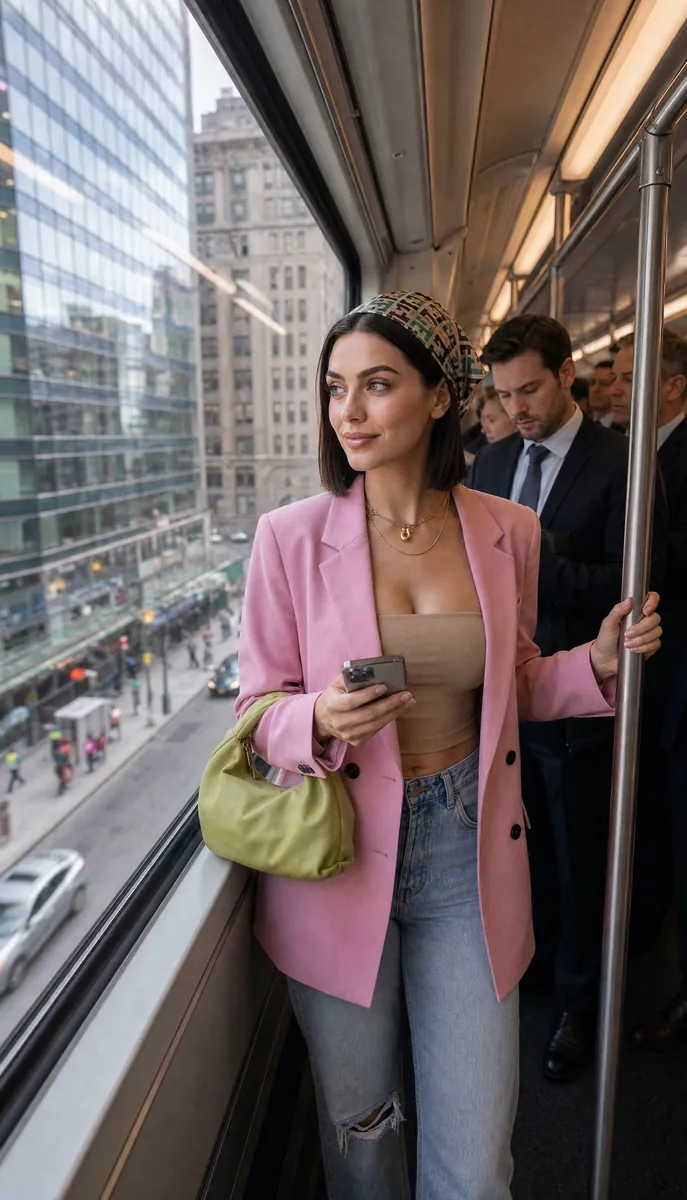
Open Dreamina, load your own face and the outfit board, and run the image prompt. You are not making a pretty picture here, you are casting the film: this frame decides the face, the outfit, the carriage and the window for the next thirty seconds.
Choose Seedance 2.5, 9:16, 30 s. The finished still is the only reference the video prompt needs. Everything the clip has to hold steady is already inside it.
3
Fix the one bad stretch
A thirty second take almost never lands perfectly on the first run. Edit Segment lets you mark the stretch that failed and regenerate only that, instead of starting over from a new seed.
Dreamina generates a clip in one piece.
Edit Segment lets you go back into a finished video, mark one stretch, and describe what should
change there. Only that stretch is regenerated. Everything before and after stays exactly as it
was. Without it, one bad second means a whole new clip from a new seed, and the parts you already
liked are gone with it.
1
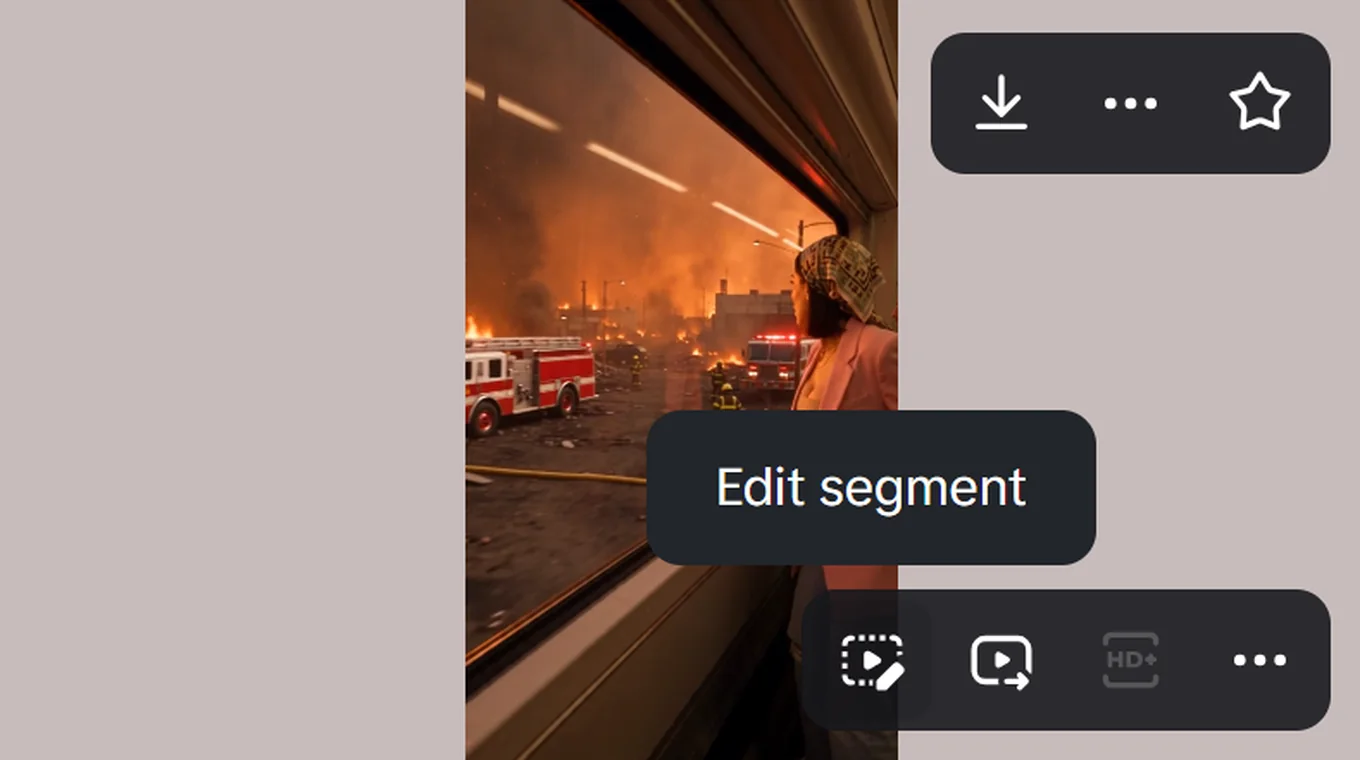
Hover the finished video
In your workspace, move the mouse over the clip. A toolbar appears on top of it. Click Edit segment.
The toolbar on the finished clip
2
Mark the stretch
Drag the selection box on the timeline strip over the part you want to change. The preview above follows the selection. Four seconds is the shortest window the tool accepts.
Four seconds selected, 19.8 s to 23.8 s
3
Describe the change
Type what should change inside that segment. You can attach a reference image with the plus slot next to the field. Send it with the arrow button.
The prompt field and the price of one run
Prompt one of two
Dreamina9:16Still image
The image, before anything happens
A calm commuter train, a
huge window on the left, you on the right looking out. Get this one right and the video has
nothing left to invent.
Result
Tool
Dreamina
Ratio
9:16
Output
One still
Load these two
@image1Your faceYour own
@image2The outfit
The image promptScroll to read
Create a highly photorealistic cinematic vertical 9:16 image inside a modern moving metropolitan city train.
REFERENCE PRIORITY:@image1 = EXACT identity and facial reference for the person.
@image2 = exact outfit, accessories, head styling, and overall fashion reference.
Do not use any additional location or composition reference.
IDENTITY IS CRITICAL:
The person must remain unmistakably identical to @image1.
Preserve the exact facial proportions, bone structure, eye color and shape, eyebrows, nose, lips, jawline, cheek structure, skin tone, hairline, and overall identity.
Do not reinterpret, beautify, stylize, age, or replace the face.
The person should clearly look like the exact same individual from @image1, naturally placed into this environment.
PERSON AND STYLING:
The subject is an adult person with realistic natural skin texture, visible pores, believable anatomy, and natural proportions.
Use @image2 for the exact outfit direction, colors, fit, layering, accessories, handbag, headwear, jewelry, and styling.
If @image2 includes a scarf, hat, sunglasses, handbag, or other accessory, preserve it accurately and integrate it naturally into the pose.
The overall styling should feel polished, fashionable, expensive, and sophisticated without looking like a staged fashion campaign.
POSE:
The person stands naturally inside the moving train beside a huge panoramic window.
They are positioned mostly on the RIGHT SIDE of the vertical frame.
Their body is shown approximately from knee or mid-thigh upward.
They stand slightly angled toward the window, not directly facing the camera.
They hold a smartphone casually in one hand but are NOT looking at it.
Instead, their head and gaze are turned toward the large window as they look outside at the passing city.
Their expression is calm, thoughtful, slightly curious, and natural.
With the other hand, they clearly hold a vertical stainless-steel train pole for balance.
The grip should look functional and relaxed, as if the train is moving.
The person should not appear to be posing for the camera.
If the outfit includes a handbag, it should hang naturally from the forearm, shoulder, or hand according to the reference.
No floating accessories.
No handbag attached to the train pole.
COMPOSITION:
Create an environmental cinematic shot rather than a close portrait.
A huge panoramic train window dominates the LEFT SIDE of the 9:16 frame.
The window occupies roughly half or more of the image width and extends from around knee-height or slightly lower toward the ceiling.
The person remains toward the RIGHT SIDE so they do not block the outside view.
The camera is several feet away at approximately chest-to-eye level.
Use a realistic slightly wide cinematic perspective, around a 28–35mm full-frame lens equivalent.
Show the main person, large window, vertical poles, commuters, and depth through the carriage.
Visual hierarchy:
huge panoramic train window
moving city outside
realistic train interior
main person
background commuters
TRAIN DESIGN:
The train is a modern premium metropolitan commuter train for a large international city.
It should feel newly built, contemporary, realistic, functional, spacious, and slightly upscale.
It is NOT a subway with tiny windows.
It is NOT a high-speed long-distance train.
It is NOT a tram.
It is NOT futuristic or sci-fi.
The carriage has a long, open interior with believable depth.
Use:
large panoramic side windows
narrow dark metallic window frames
matte light-gray and off-white wall panels
brushed metal details
dark-gray practical flooring
slim vertical stainless-steel poles
subtle horizontal overhead handrails
discreet ceiling vents and panel seams
long narrow warm-neutral ceiling lights
modern sliding doors farther down the carriage
small amounts of dark charcoal or muted navy seating deeper in the background
The standing area beside the panoramic window should remain open and spacious.
Do not place rows of seats directly in front of the main window.
The large glass panels should show subtle realistic reflections of passengers, poles, and ceiling lights without hiding the city outside.
The carriage should feel clean and premium, but genuinely used by everyday commuters.
Include subtle imperfections such as realistic seams, hardware, faint floor wear, and natural reflections.
No spaceship interior.
No sterile white futuristic corridor.
No neon lighting.
No excessive luxury.
OUTSIDE THE WINDOW:
The outside world is still completely normal and peaceful.
Show a realistic contemporary metropolitan city passing beside the elevated train.
Include:
modern glass office towers
older stone and concrete architecture
streets below
cars
small pedestrians
intersections
distant buildings
layered urban depth
subtle horizontal motion blur from the moving train
The train appears to be traveling above or alongside city streets, giving a broad elevated view.
The city should feel active, populated, realistic, and contemporary.
No destruction.
No fantasy.
No disaster.
No strange weather.
No futuristic skyline.
BACKGROUND COMMUTERS:
Include around 3–5 clearly visible adult professional commuters, with a few more subtle figures deeper in the carriage if needed.
They wear realistic city business clothing such as dark navy or charcoal suits, shirts, coats, ties, and understated office wear.
Their behavior must feel varied and natural.
For example:
one passenger checks their phone
another looks out the window
another holds a pole
one commuter looks down the carriage
others are partially obscured in the background
Do not make everyone look in the same direction.
Do not make every passenger hold a phone.
Do not make them stare at the main subject.
They should feel like ordinary commuters absorbed in their own routines.
LIGHTING:
Natural cool daylight enters strongly through the huge window.
Subtle warm-neutral practical train lighting comes from above.
The contrast between exterior daylight and interior lighting should feel sophisticated and realistic.
Skin tones remain neutral and believable.
Use:
soft highlight rolloff
natural shadows
realistic glass reflections
visible skin texture
detailed fabric texture
subtle cinematic film grain
believable depth of field
mild handheld-camera authenticity
gentle motion blur outside
Avoid heavy artificial bokeh.
Avoid beauty lighting.
Avoid orange, yellow, brown, or beige color grading.
MOOD:
Calm.
Elegant.
Observational.
Slightly mysterious.
Natural.
Cinematic.
The image should feel like the quiet opening frame of a premium cinematic short film before anything unusual begins.
Everything still appears normal.
IMPORTANT:
Keep the exact identity from @image1.
Keep the exact outfit and styling from @image2.
Do not depend on any composition reference image.
The panoramic window must dominate the LEFT SIDE.
The person must stand toward the RIGHT SIDE.
The person holds a phone but looks outside.
The other hand clearly holds the train pole.
The train must look like realistic modern metropolitan public transport.
Commuters behave independently and naturally.
No social-media interface.
No text.
No captions.
No icons.
No watermark.
No generic AI face.
No altered identity.
No plastic skin.
No exaggerated anatomy.
No distorted hands.
No duplicated passengers.
No floating accessories.
No sci-fi train.
No overly orange or beige cinematic grading.
Prompt two of two
Seedance 2.59:1630 s
The video, one position, no cuts
One phone, one seat, five
tunnels and five worlds. Every beat carries the second it happens on, so read the timeline before
you generate.
Result
Model
Seedance 2.5
Ratio
9:16
Length
30 s
Load this one
@image1Your stillFrom step one
The video promptScroll to read
30-SECOND PHOTOREALISTIC LIVE-ACTION VIDEO — VERTICAL 9:16 ONE CONTINUOUS HANDHELD TAKE — SAME CAMERA POSITION FOR ALL 30 SECONDS
REFERENCES@image1 — THE GENERATED STILL FROM THE IMAGE PROMPT — HIGHEST PRIORITY Preserve the exact facial structure, eyes, eyebrows, nose, lips, jawline, cheekbones, skin tone and natural skin texture in every frame, and the same body proportions, hairstyle, clothing, accessories, age and overall appearance throughout. Also keep the carriage, the panoramic window, the poles and the passenger positions from @image1 as the starting frame of the take. The main character is the person from @image1.
CORE CONCEPT
A passenger records one uninterrupted handheld phone video inside a real moving train. At first everything is normal. A calm automated announcement says: "Next stop: the end of the world." There is no other announcement. Immediately after the sentence, the train accelerates violently to an extreme speed and never slows down again. It races through several realities, using very short physical railway tunnels as transitions. The first worlds pass quickly; the final reset and regenerated world receive more screen time. Everything must feel spontaneous, physical and real — never like an AI showcase or digital background.
CAMERA — ABSOLUTE PRIORITY
ONE CAMERA. ONE OPERATOR. ONE PHYSICAL POSITION. ONE UNINTERRUPTED TAKE. The phone stays in the same spot inside the carriage for all 30 seconds. The same window remains in the same part of the frame. The same passengers, seats, rails, doors, ceiling and floor remain in the same places from first frame to last frame. The camera may shake, sway and make grip corrections, especially during jolts, but it never relocates, changes sides or moves outside. Every shake returns to the same framing. Natural handheld movement only: subtle hand shake, train vibration, body sway, grip corrections, stronger jolts during impacts. Every frame is what one passenger sees through one phone from one fixed seat-height viewpoint and focal length.
EXTREME SPEED / PARALLAX
After the announcement the acceleration is physically obvious: passengers shift backward, hair and loose clothing react, the camera operator is pushed slightly. From about 2 seconds onward the train maintains the same frightening extreme speed until the final frame. Near objects become streaks: tunnel walls, poles, barriers, track equipment, trees, signs. Mid-distance roads, cars, houses and buildings remain briefly recognizable but race past. Far objects move more slowly with physically correct parallax. Nothing outside is ever held for the viewer. Dramatic events are only glimpsed as the train races past. The train never slows down to show anything.
PASSENGERS
Nobody is static. Passengers constantly make small unsynchronized natural movements: shifting posture, adjusting feet, reacting to jolts, holding rails or seats, looking at each other, checking windows, losing and regaining balance, talking over one another, breathing harder and gripping supports more strongly as fear rises. Reactions happen at different moments; they feel like real individuals, not synchronized extras.
MAIN CHARACTER
At first the person from @image1 casually holds or uses their phone and is relaxed. After the announcement and acceleration they react physically, steady themselves and look around. When they see the tornado, they quickly put their phone away completely so both hands are free. They take one or two small natural steps backward during a jolt and grab a nearby rail, seat or handhold. As events intensify they hold on increasingly firmly and sway with the train. Emotional progression: calm → confused → concerned → frightened → shocked → overwhelmed → bracing for impact → stunned → cautiously relieved.
AUDIO
Natural live sound only: wheels, rails, mechanical rumble, wind, carriage vibration, rattling, tunnel resonance and pressure changes. Passenger reactions may overlap naturally: "What is going on?" "What the hell?" "Look!" "Hold on!" "What is that?" "NO!" Gasps and short frightened screams are allowed. No clean movie-style dialogue. Loud train noise may partially cover voices.
OPENING ANNOUNCEMENT
At the very beginning, while the train still moves normally, the PA activates. A calm normal public-transport voice says clearly: "Next stop: the end of the world." Passengers briefly process it, exchange confused looks, then the train accelerates violently. NO MORE PA ANNOUNCEMENTS.
WINDOW REALISM
All exterior events are seen through real train glass with subtle reflections, fingerprints, smudges, scratches, occasional rain, glare and correct motion blur. Inside tunnels the window becomes dark and reflective; after exits, exterior detail dominates again. The window must never look like a screen.
WORLD REALISM
Every world is functioning and alive: cars, pedestrians, emergency crews, wind, debris, water, firefighters, birds, smoke and emergency lights. The camera never composes the spectacle; the train simply races past it.
TUNNELS
Every major transition before the final reset uses a real railway tunnel. The first four tunnels are extremely short, roughly one second each. Transition: world → visible dark tunnel mouth growing ahead → entrance → rapid darkness and flashing tunnel lights → bright exit already visible ahead → next world. The next world is already fully formed and active through the tunnel exit before the train reaches it. NO morphing, magical assembly or slow tunnel transitions.
TIMELINE0–2s — ANNOUNCEMENT + ACCELERATION
The train moves normally. The main character casually holds their phone. The PA says: "Next stop: the end of the world." Passengers look up. Immediately after the sentence the train accelerates extremely hard. Camera jolts, passengers shift backward, someone grabs a rail. Near trackside details turn from readable to streaks within half a second. A tunnel mouth is already visible ahead and rapidly grows larger. The train reaches full extreme speed and is inside Tunnel 1 by 2 seconds.
2–3s — TUNNEL 1
The train blasts through a very short tunnel. Fast tunnel lights, dark reflective glass, strong vibration. Daylight appears almost immediately.
3–6s — TORNADO WORLD
The train explodes out into a violent inhabited storm: heavy rain, bending trees, moving cars, pedestrians running for shelter, emergency vehicles, loose debris, flashing traffic lights, power lines moving in strong wind. A huge believable tornado is visible in the middle-to-far distance. The main character sees it, immediately becomes serious, looks toward another passenger, puts their phone away completely, then a jolt makes them step back and grab a rail. A passenger says: "What is going on?" Someone gasps. The carriage becomes noticeably more nervous.
6–7s — TUNNEL 2
Another extremely short tunnel. Everyone is more alert. The main character holds on. Rapid tunnel lights, immediate exit.
7–10s — FLOODED WORLD
A flooded but active city: muddy moving water, stranded vehicles, emergency crews, rescue boats farther away, people carrying belongings, flashing vehicles, damaged storefronts, people moving through shallow water, continuing rain. At about 8.5s a large wall of brown floodwater is already visible approaching from the side. At about 9s it slams into the side of the train and breaks against the window with a heavy dull impact. Water sheets across the outside of the glass in fast translucent streams for about one second before airflow strips it away. THE WINDOW IS NEVER FULLY COVERED OR BLANK. The flooded city remains partially visible through distorted running water, while the interior, passengers and main character stay visible and lit. Passengers flinch and shout. The carriage rocks sideways. The main character pulls back and grips harder. Someone says: "What the hell is happening?"
10–11s — TUNNEL 3
Very fast tunnel. Darkness, rapid lamps, vibration and reflections of frightened passengers. Immediate exit.
11–14s — FIRE / SMOKE WORLD
The train exits into a realistic city affected by severe wildfire: moving thick smoke, orange-gray sky, firefighters working, emergency vehicles driving, pedestrians evacuating, trees moving in hot wind, ash, scattered realistic fires, distant burning vegetation. Fires remain separate, with intact areas between them. Passengers speak over one another. The main character grips the rail harder. Someone sees something outside and yells: "NO!" A short frightened scream follows.
14–15s — TUNNEL 4
A violent, very short tunnel. Everyone braces. Camera shakes harder. Tunnel walls race past; darkness is brief.
15–18s — COLLAPSING / END-OF-WORLD REALITY
The train exits into the most disturbing world yet, still photorealistic and grounded. A recognizable city is failing: huge smoke columns, damaged infrastructure and buildings, abandoned traffic, distant fires, electricity failures, debris, dark unstable sky, people running, emergency vehicles trying to move, birds fleeing overhead. Several dark-grey military helicopters move low and fast through the smoke, crossing naturally rather than hovering. Nearby rotor sound may cut through the train noise. Something enormous is happening on the distant horizon. Passengers are visibly terrified. Someone whispers: "What is that?"
18–22s — RESET EVENT
Far beyond the city, a rocket-like catastrophic event begins. A brilliant vertical column of fire and energy erupts from the horizon like an impossibly powerful rocket ignition. It punches through the clouds and forms a massive expanding cloud at its base. Then a clearly visible circular pressure wave explodes outward across the ground and atmosphere. Buildings, smoke, trees and debris react as it passes. The wave races directly toward the train. Passengers see it coming and panic. Someone screams: "NO!" The main character braces with both hands. Others grab rails, handles and seats; some crouch slightly.
22–23s — PRESSURE WAVE IMPACT
The pressure wave slams into the moving train. This is the most violent physical moment. The camera jolts heavily but stays in the same hands and position. The carriage shakes; passengers are thrown slightly sideways or backward but remain believable. The main character tightens both hands around the support. Passengers gasp or scream. Interior lights flicker. Dust, light and atmospheric distortion briefly overwhelm the exterior view. The train never slows. Another tunnel is already ahead.
23–25s — TUNNEL 5 / DARK TUNNEL
Tunnel 5 is already visible while the wave hits, and the train runs straight into it. This tunnel always separates the destroyed world from what follows. It is almost completely pitch black. The interior lights are out. Only tiny traces of emergency light, distant tunnel lamps or passing reflections briefly reveal faces. Sound is dominated by wheels, tunnel resonance, breathing and frightened movement. Everyone is recovering while still holding on. The camera remains in exactly the same location. Far ahead, a small bright exit appears and grows larger. Natural daylight slowly reaches into the carriage.
25–30s — REGENERATED WORLD
The train exits into an entirely different Earth. Give this world the full final five seconds. It is green, intact, peaceful and COMPLETELY EMPTY OF PEOPLE. Nature has reclaimed the still-standing city. The only exterior movement is wind, water, birds and leaves: long grass moving in waves, mature trees shifting, ivy and creepers swaying on buildings, clean rivers and canals flowing, birds crossing the sky or settling on roofs and trees, dust and seed heads drifting through light. Visible: wide green spaces where streets once were, huge mature trees, meadows of long grass, intact old and modern buildings covered in vegetation, grass-filled squares, clean river and canals with stone bridges, green rooftops, young trees growing through roads, parked vehicles overtaken by plants, birds on wires, roofs and in the air. Everything is whole, not ruined — a city continued without humanity. THE STREETS, SQUARES, CAFES, WINDOWS AND BRIDGES ARE EMPTY. NOT ONE PERSON IS OUTSIDE. The air is clean. Light is soft, natural and slightly warm. The train still moves at the same extreme speed, but broad open views make the world understandable. Use strong realistic parallax: near vegetation streaks past, mid-ground buildings move quickly, distant green city and horizon move more slowly.
FINAL PASSENGER REACTIONS
Passengers do not suddenly smile. They are recovering from genuine shock. At first they still grip supports, breathe heavily and try to understand what happened. Then they slowly notice the new world. The carriage becomes quiet. The main character looks through the window. Fear changes to disbelief and cautious relief. They slowly loosen their grip and relax their shoulders, but remain serious and emotionally overwhelmed. Other passengers react quietly: someone releases an overhead handle, someone moves carefully closer to the window, someone sits back down, someone catches their breath. One person may softly whisper: "Oh my God..." Final emotion: relief + disbelief + awe + exhaustion.
FINAL FEELING
The last seconds feel almost meditative after the chaos. The train remains extremely fast, but emotionally everything slows down. Nobody panics anymore. The same phone keeps recording as frightened passengers silently realize the world outside has somehow started again.
ABSOLUTE FINAL RULES
Same carriage framing, window, passengers and physical camera position for all 30 seconds. One continuous handheld take; no cuts or camera changes. Only opening announcement: "Next stop: the end of the world." Immediate extreme acceleration; train never slows afterward. Five tunnels total: four short transitions + dark Tunnel 5 after the pressure-wave impact. Next world is already fully formed and visible through every tunnel exit. Main character puts phone away after seeing tornado; passengers become progressively more frightened and reactive. Floodwater hits window around 9s without fully obscuring it. Military helicopters cross collapsing city. Rocket-like reset, visible pressure wave and physical impact on train. Strong impact shake without camera relocation. Regenerated world lasts 25–30s and is completely empty of people; only wind, water, birds and leaves move outside. Passengers recover slowly without sudden smiling. Photorealistic live action, natural humans, real train physics, reflections, motion blur and parallax. No AI morphing, fantasy concept art, glossy disaster-movie camera work or static passengers.
Now go and take your own train to the end of the world.
Two prompts, one still, thirty seconds.
Swap the city, swap the worlds, keep the camera where it is. Tag me when you post. I want to see
what your window looks like.