Free Prompt Collection

Steal My
Prompt

Las Vegas Hangover Edition

Twenty prompts that build one night in Las Vegas — three friends, a cheap 2009 flash camera and a story that ends with a lion in the bed.

with @nala_vae · @digitalmarketing.gold

20 Prompts Nano Banana Pro 9:16 OpenArt
The Lift Doors Open Rooftop Start Limo Floor Parrot in the Tiki Bar Parrot at the Poker Table The Big Hand The Stranger at the Slots The Ruined Shot Gold Bars in the Lobby Wine into the Police Van Karaoke Club with the Gold Under the COCKTAILS Sign The Chimp Tattoos the 67 Lifting the Lion Lion on the Flamingo Lift Selfie with the Lion The Room Service Trolley The Ice Machine The Lion Has the Bed

Tap a frame to jump to its prompt


Mia Maldini
Mia Maldini How it works
Three steps

Six references,
one crew

  1. 1
    Pick the model

    Open OpenArt and choose Nano Banana Pro. Set the aspect ratio to 9:16.

    Go to OpenArt
  2. 2
    Load six references, in this order

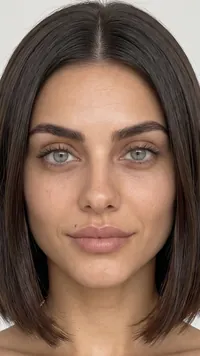
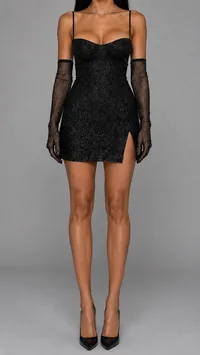
    Three people, two images each — a face and an outfit. The order is what tells the model who is who, so keep it exactly as shown below. The thumbnails are examples, not files to use.

  3. 3
    Paste and generate

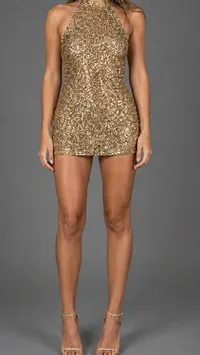
    Copy any prompt from the following pages and paste it unchanged. The prompts never name anyone and never describe clothing — everything comes from your six references.

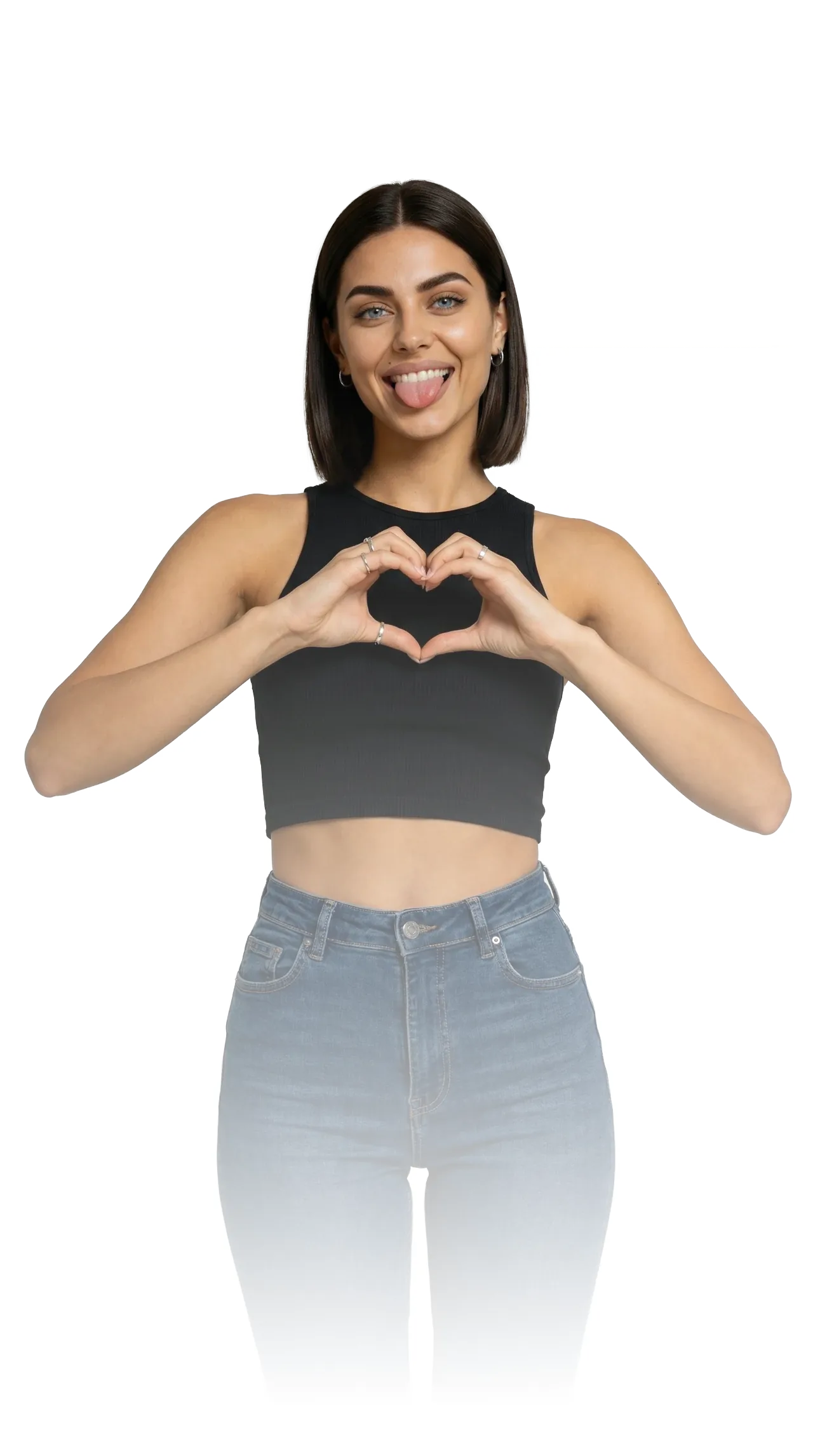
Person 1
@image1Face reference
@image2Outfit reference
Person 2
@image3Face reference
@image4Outfit reference
Person 3
@image5Face reference
@image6Outfit reference
Mia Maldini Before you start
Good to know

Three things
worth knowing

Two minutes before you start. These three come up more than anything else.

Want more grain?

These images already come out grainy. If you like it stronger, just add grain yourself once the image is done — Lightroom, Photoshop or any photo app on your phone will do it in a few seconds, and you can see exactly how far you are going.

Not only Nano Banana Pro

The prompts are written plainly, not for one model. GPT Image 2.0 renders them as well — the look shifts a little, the scene stays. Try the same prompt in both and keep the one you prefer.

Only two people instead of three?

Paste the prompt into ChatGPT with one line in front: Please rewrite this prompt for two people instead of three, keep everything else exactly as it is. It rebuilds the CAST block and drops Person 3 from the scene. Same for four.

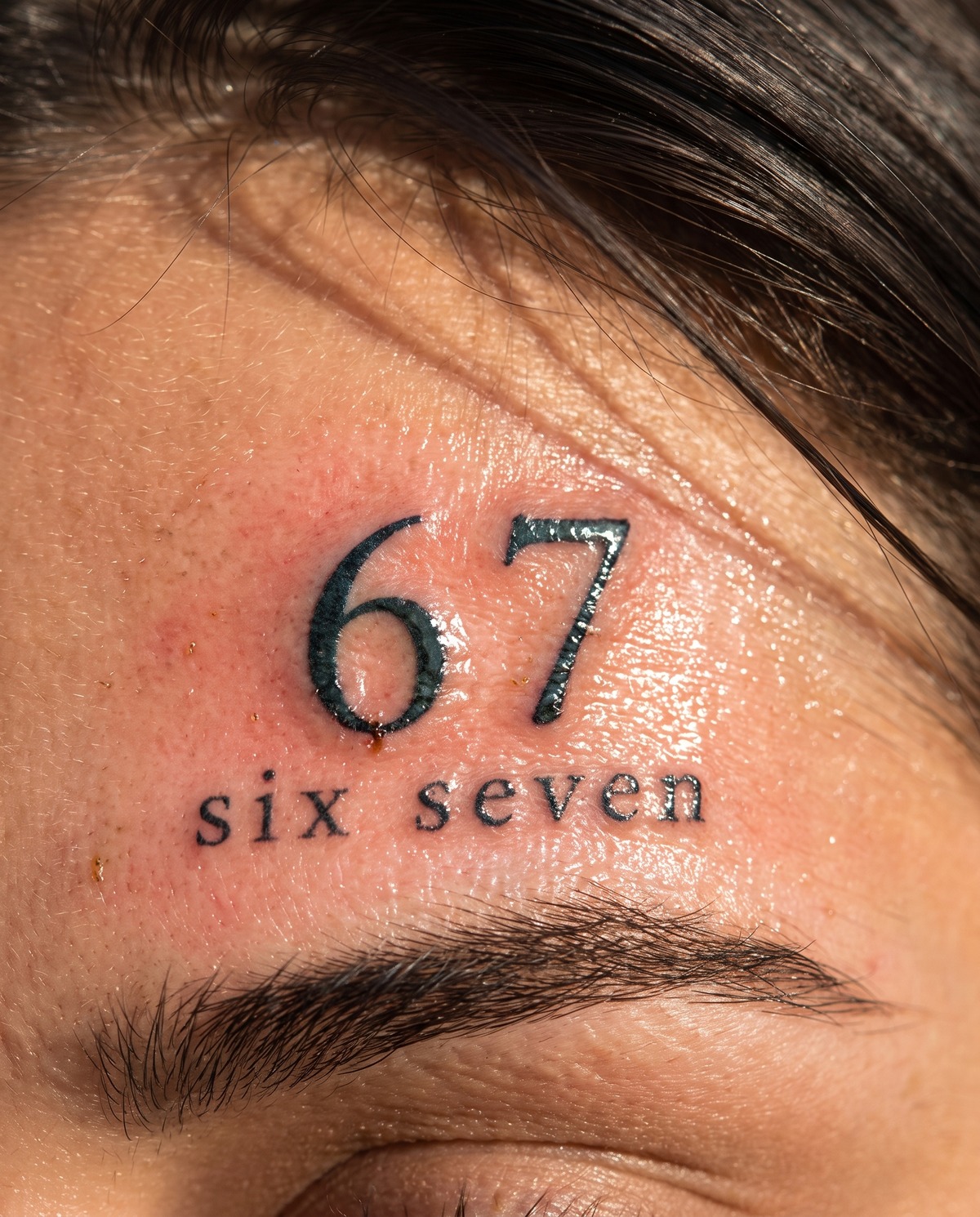
67
One gag runs through the whole set

A crooked 67 gets tattooed on Person 1’s forehead. Prompts 01–13 are without it, prompt 14 is the moment it is made, and 15–20 carry it finished. Generate them in order and the night tells itself. From prompt 15 on you can also hand this photo in as an extra reference, then the 67 comes out exactly like this one.

67 tattoo reference Download
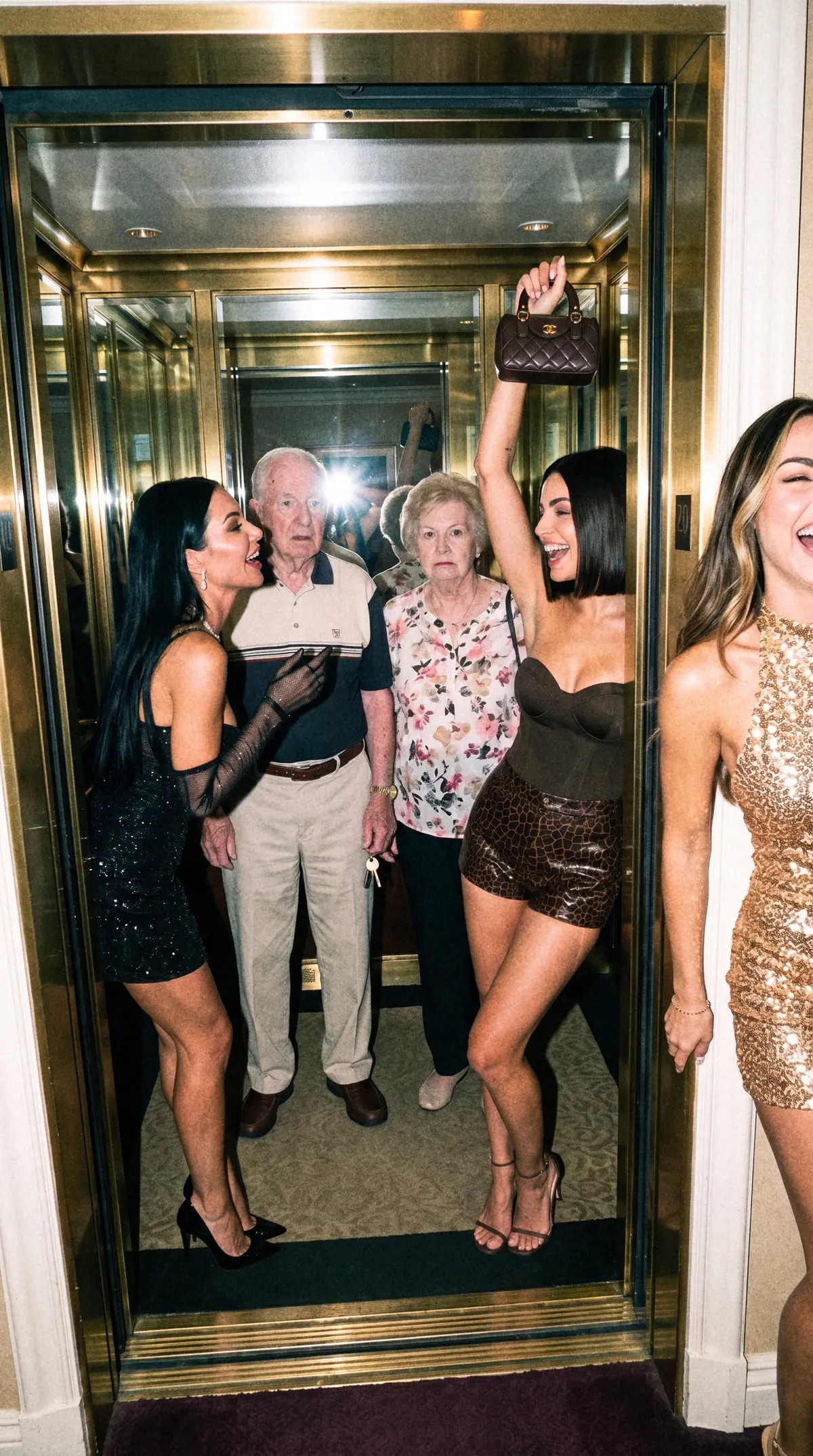
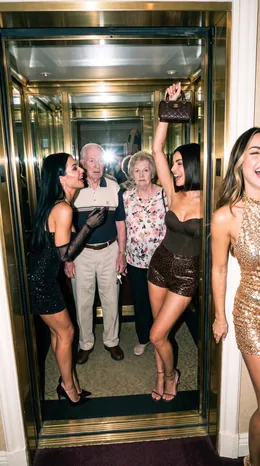
The Lift Doors Open
01

The Lift Doors Open

Mirrored lift · Cornered pensioners · Flash

🚪 Brass lift Deadpan bystanders Tilted frame
CAST — three specific people, locked to the reference images. image1 = Person 1 identity reference image2 = Person 1 outfit reference image3 = Person 2 identity reference image4 = Person 2 outfit reference image5 = Person 3 identity reference image6 = Person 3 outfit reference Person 1 = identity from image1 + outfit from image2 Person 2 = identity from image3 + outfit from image4 Person 3 = identity from image5 + outfit from image6 THE MOMENT — the doors of a brass and mirrored hotel lift have just slid open and the flash has fired straight into it. An elderly couple is standing inside, cornered: an old man in a polo shirt and beige trousers and an old woman in a floral blouse, both facing front, completely deadpan, the old woman looking flatly into the lens. Person 2 is inside the lift on the left, leaning in towards the old man mid-sentence with her mouth open and one gloved hand raised near his shoulder, telling him something urgent. Person 1 is inside on the right, caught mid-step with one arm stretched straight up holding a small handbag high above her head, laughing, weight on the ball of one foot. Person 3 is outside the lift at the right edge of the frame, half cut off by the door frame, head tipped back laughing at something else entirely. The flash burns a white star into the mirrored back wall. Shot from the corridor, slightly tilted, the whole lift framed by its brass doorway. CAMERA A cheap 2009 pocket compact with direct on-camera flash. Harsh and unflattering: whatever is nearest the lens is slightly blown out and shiny, everything a few metres back drops away into dark, noisy murk. Ugly mixed white balance — warm ambient light fighting cold flash, green in the shadows, magenta in the highlights. Visible sensor noise, JPEG mush in the dark areas, crunchy oversharpened edges. Skin keeps its texture and pores, but nobody has red blotches, rashes, broken veins, sunburn or red marks on the face — skin tone stays even and matches the identity reference. No smoothing, no gloss, no beauty retouch. Absolutely NO date stamp, NO timestamp, NO text, NO numbers and NO watermark anywhere in the frame. NOT A PHOTOSHOOT — THE MOST IMPORTANT COMPOSITION INSTRUCTION Nobody poses. No hand on hip, no weight shifted onto one leg, no chin tilt, nobody lined up side by side smiling into the lens, no one presenting themselves to the camera in any way. The photographer was not ready either. The horizon is tilted. Someone is cut off by the frame edge. Something is too close to the lens. At least one face is turned away or softened by movement. Bodies sit at random angles and different heights, overlapping. The result should read as a bad photograph of a real moment — not a good photograph of a staged one. If the image would work as an advertisement, it is wrong.
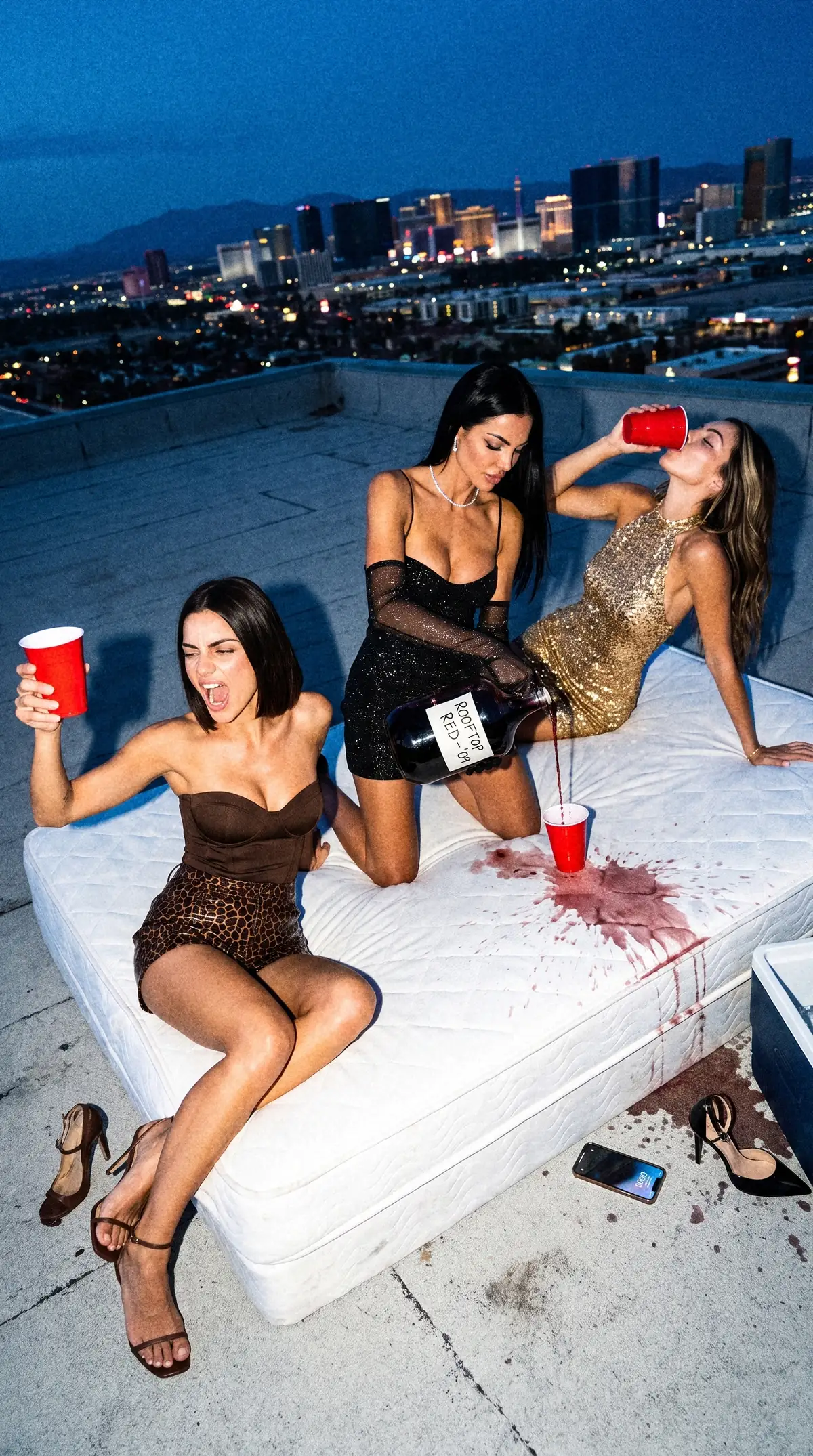
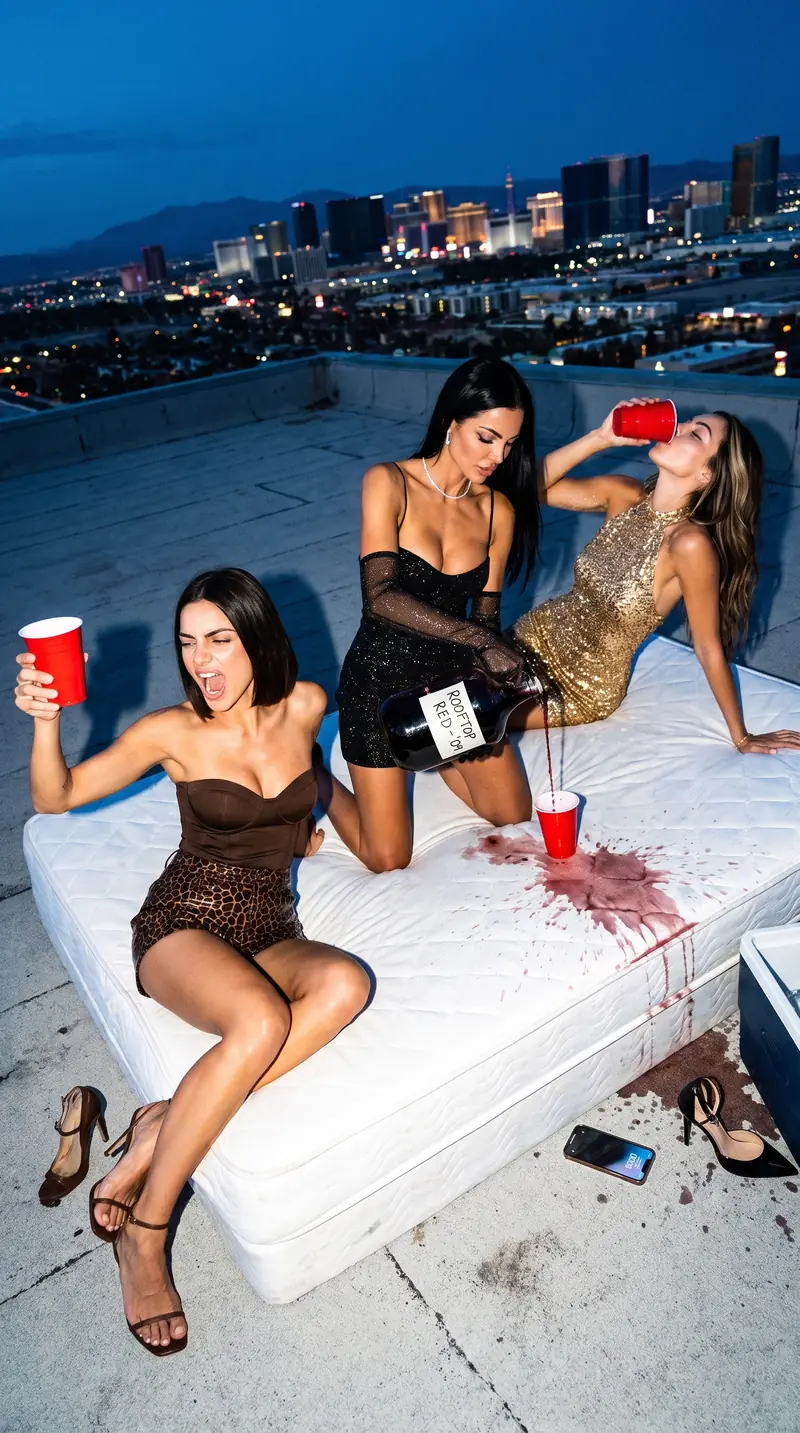
Rooftop Start
02

Rooftop Start

Blue hour · Bare mattress · Homemade red wine

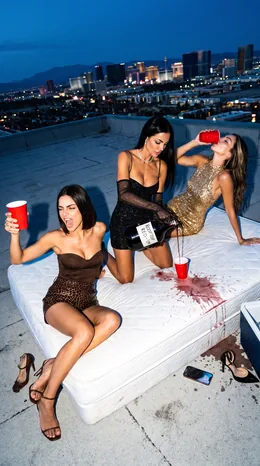
🍸 Red plastic cups Vegas skyline Spilled wine
CAST — three specific people, locked to the reference images. image1 = Person 1 identity reference image2 = Person 1 outfit reference image3 = Person 2 identity reference image4 = Person 2 outfit reference image5 = Person 3 identity reference image6 = Person 3 outfit reference Person 1 = identity from image1 + outfit from image2 Person 2 = identity from image3 + outfit from image4 Person 3 = identity from image5 + outfit from image6 IDENTITY DISCIPLINE — THIS IS THE MOST COMMON FAILURE. AVOID IT. The three must read as three clearly different individuals. Copy each face from its own identity reference exactly: face shape, eyes, eyebrows, nose, mouth, skin tone, hair colour, hair length and hair style. Never blend two references into one face. Never give two people in this image the same face or the same hair — if two of them look alike, the image is wrong. Each outfit belongs to one person only: the clothing in image2 is worn ONLY by Person 1, the clothing in image4 ONLY by Person 2, the clothing in image6 ONLY by Person 3. Derive every garment only from that person's own outfit reference — exact pattern, exact texture, exact colour. Do not move a garment, a colour, a fabric or a print from one person to another, and do not invent a different outfit for anyone. Exactly three referenced people, each appearing exactly once. No fourth lookalike, no duplicate of anyone. THE MOMENT — the very start of the night, blue hour on a flat bare concrete rooftop. A low parapet wall, and behind it the whole lit-up Las Vegas skyline under a deep blue sky. A single bare white mattress has been dragged out onto the concrete and the three of them are sitting on it. A big glass demijohn of dark homemade red wine with a handwritten paper label stuck on it. Person 2 kneels in the middle of the mattress holding the heavy demijohn with both hands and pouring it badly into a red plastic cup — wine is missing the cup, running down and soaking into the mattress in a dark red spreading stain. Person 1 sits on the near edge of the mattress in the foreground, twisted round with her arm out holding up her own red cup to be filled, mouth open, shouting something over her shoulder. Person 3 is on the far side of the mattress, leaning back on one hand with her head tipped right back, drinking straight from her cup with her eyes closed. Kicked-off high heels on the concrete, a phone lying face up with the screen on, a cool box at the edge of the frame. Shot from standing height looking down at them. CAMERA A cheap 2009 pocket compact with direct on-camera flash. Harsh and unflattering: whatever is nearest the lens is slightly blown out and shiny, everything a few metres back drops away into dark, noisy murk. Ugly mixed white balance — cold blue dusk fighting the warm flash, green in the shadows, magenta in the highlights. Visible sensor noise, JPEG mush in the dark areas, crunchy oversharpened edges. Skin keeps its texture and pores, but nobody has red blotches, rashes, broken veins, sunburn or red marks on the face — skin tone stays even and matches the identity reference. No smoothing, no gloss, no beauty retouch. Absolutely NO date stamp, NO timestamp, NO numbers and NO watermark anywhere in the frame; the only writing is the handwritten label on the wine bottle. NOT A PHOTOSHOOT — THE MOST IMPORTANT COMPOSITION INSTRUCTION Nobody poses. No hand on hip, no weight shifted onto one leg, no chin tilt, nobody lined up side by side smiling into the lens, no one presenting themselves to the camera in any way. The photographer was not ready either. The horizon is tilted. Someone is cut off by the frame edge. Something is too close to the lens. At least one face is turned away or softened by movement. Bodies sit at random angles and different heights, overlapping. The result should read as a bad photograph of a real moment — not a good photograph of a staged one. If the image would work as an advertisement, it is wrong.
Limo Floor
03

Limo Floor

Camera on the carpet · LED strips · Sunroof open

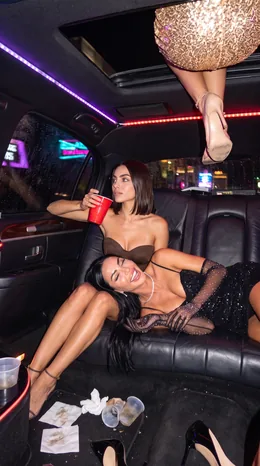
🚗 Stretch limo Worm’s-eye angle Neon sliding past
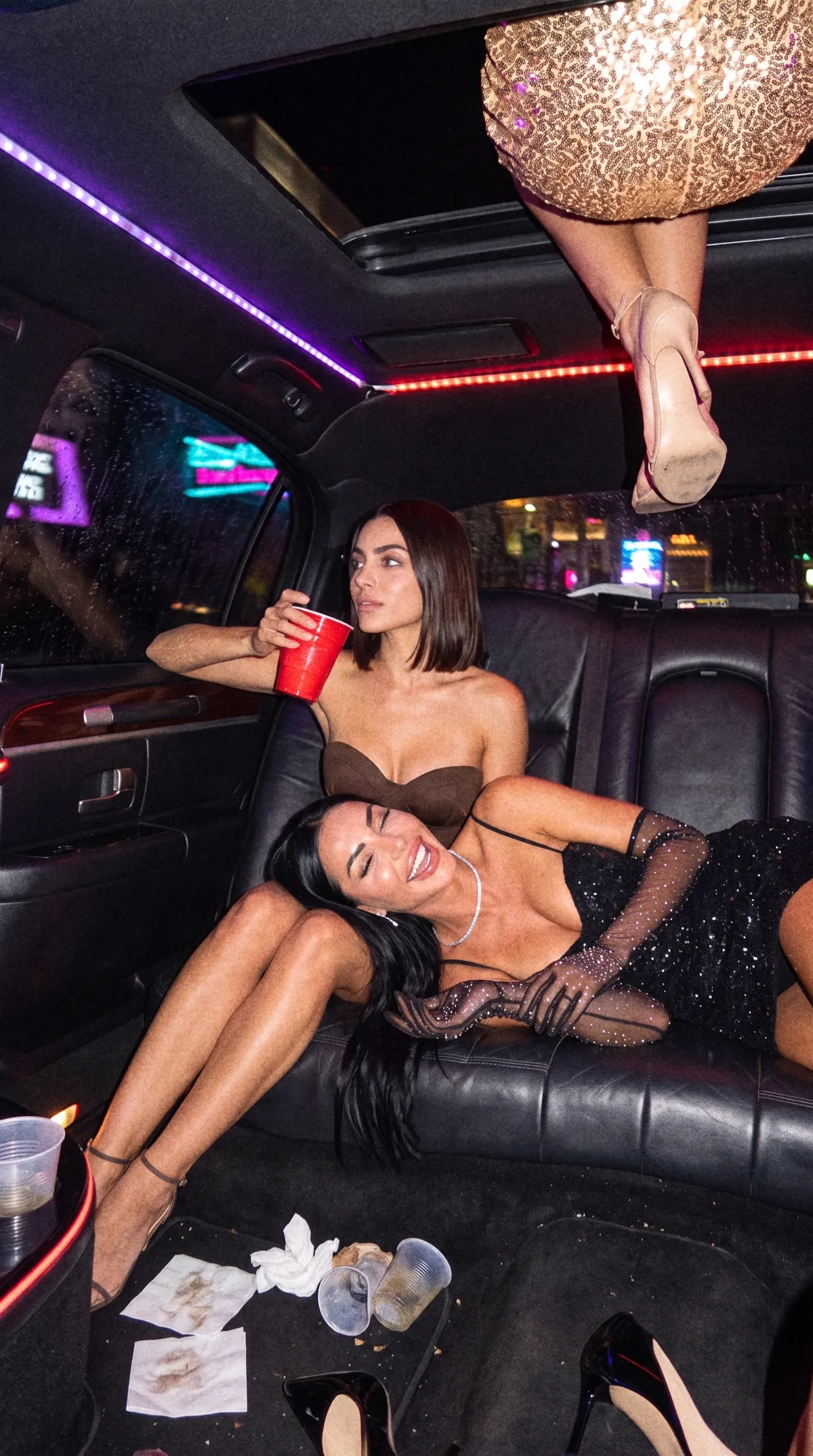
CAST — three specific people, locked to the reference images. image1 = Person 1 identity reference image2 = Person 1 outfit reference image3 = Person 2 identity reference image4 = Person 2 outfit reference image5 = Person 3 identity reference image6 = Person 3 outfit reference Person 1 = identity from image1 + outfit from image2 Person 2 = identity from image3 + outfit from image4 Person 3 = identity from image5 + outfit from image6 IDENTITY DISCIPLINE — THIS IS THE MOST COMMON FAILURE. AVOID IT. The three must read as three clearly different individuals. Copy each face from its own identity reference exactly: face shape, eyes, eyebrows, nose, mouth, skin tone, hair colour, hair length and hair style. Never blend two references into one face. Never give two people in this image the same face or the same hair — if two of them look alike, the image is wrong. Each outfit belongs to one person only: the clothing in image2 is worn ONLY by Person 1, the clothing in image4 ONLY by Person 2, the clothing in image6 ONLY by Person 3. Derive every garment only from that person's own outfit reference — exact pattern, exact texture, exact colour. Do not move a garment, a colour, a fabric or a print from one person to another, and do not invent a different outfit for anyone. Exactly three referenced people, each appearing exactly once. No fourth lookalike, no duplicate of anyone. THE MOMENT — the camera has been put down on the carpeted floor of a moving stretch limousine and is looking up and along the cabin. Purple and red LED strips run along the roof line, the sunroof is open and neon signs slide past outside the rain-flecked windows. Person 1 is sitting up on the black leather bench holding a red plastic cup, looking out of the window, not aware of the camera at all. Person 2 has collapsed sideways across Person 1's lap, lying along the bench with her head back and her long hair hanging down, laughing with her eyes shut, one gloved arm flopped over herself. Person 3 is standing up through the open sunroof: only her legs and the hem of her dress are visible at the top of the frame, cut off at the waist by the roof, one heel hanging off her foot. In the foreground, right against the lens: crushed plastic cups, greasy napkins, food scraps and two kicked-off high heels lying on the black carpet. CAMERA A cheap 2009 pocket compact with direct on-camera flash, lying flat on the floor. Harsh and unflattering: whatever is nearest the lens is slightly blown out and shiny, everything a few metres back drops away into dark, noisy murk. Ugly mixed white balance — coloured LED light fighting cold flash, green in the shadows, magenta in the highlights. Visible sensor noise, JPEG mush in the dark areas, crunchy oversharpened edges. Skin keeps its texture and pores, but nobody has red blotches, rashes, broken veins, sunburn or red marks on the face — skin tone stays even and matches the identity reference. No smoothing, no gloss, no beauty retouch. Absolutely NO date stamp, NO timestamp, NO text, NO numbers and NO watermark anywhere in the frame. NOT A PHOTOSHOOT — nobody poses and nobody knows the picture is being taken. The horizon is tilted, the framing is accidental, the rubbish in the foreground is far too close to the lens, one person is cut in half by the frame edge. A bad photograph of a real moment, not a good photograph of a staged one. If the image would work as an advertisement, it is wrong.
Parrot in the Tiki Bar
04

Parrot in the Tiki Bar

Crowded bar · Scarlet macaw · Fake palms

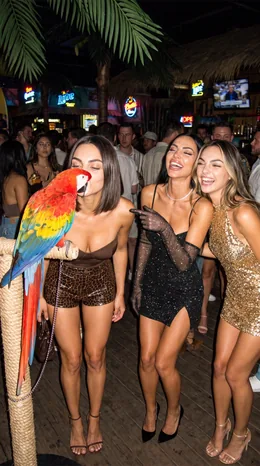
🦄 Macaw on a shoulder Packed strangers Neon bar signs
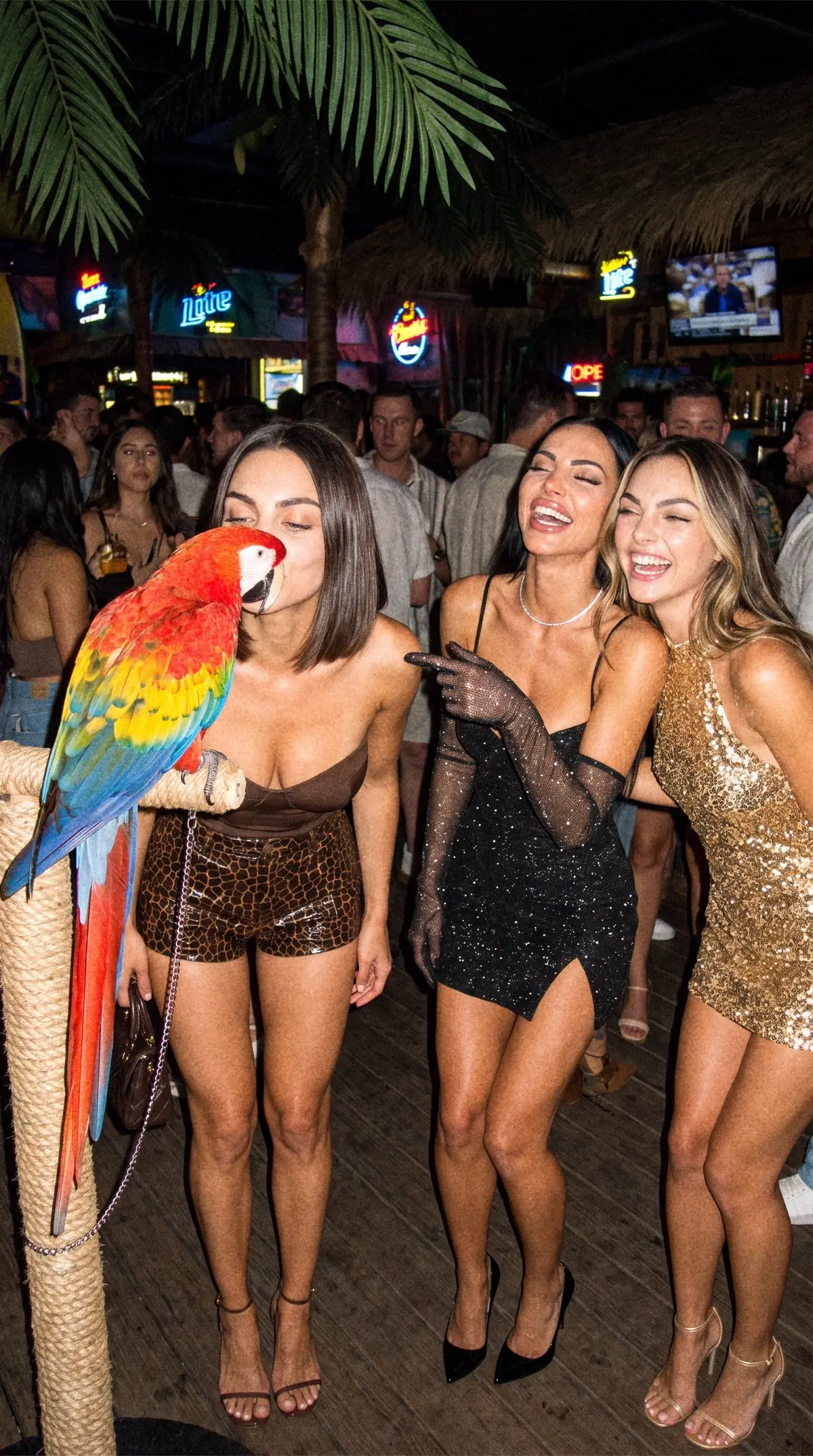
CAST — three specific people, locked to the reference images. image1 = Person 1 identity reference image2 = Person 1 outfit reference image3 = Person 2 identity reference image4 = Person 2 outfit reference image5 = Person 3 identity reference image6 = Person 3 outfit reference Person 1 = identity from image1 + outfit from image2 Person 2 = identity from image3 + outfit from image4 Person 3 = identity from image5 + outfit from image6 IDENTITY DISCIPLINE — THIS IS THE MOST COMMON FAILURE. AVOID IT. The three must read as three clearly different individuals. Copy each face from its own identity reference exactly: face shape, eyes, eyebrows, nose, mouth, skin tone, hair colour, hair length and hair style. Never blend two references into one face. Never give two people in this image the same face or the same hair — if two of them look alike, the image is wrong. Each outfit belongs to one person only: the clothing in image2 is worn ONLY by Person 1, the clothing in image4 ONLY by Person 2, the clothing in image6 ONLY by Person 3. Derive every garment only from that person's own outfit reference — exact pattern, exact texture, exact colour. Do not move a garment, a colour, a fabric or a print from one person to another, and do not invent a different outfit for anyone. Exactly three referenced people, each appearing exactly once. No fourth lookalike, no duplicate of anyone. THE MOMENT — a crowded tropical-themed bar in Las Vegas at night. Bare wooden deck floor, big fake palm fronds hanging into the top right corner, glowing neon bar signs on the back wall, a TV screen, a packed crowd of young strangers standing shoulder to shoulder behind them with drinks. A large scarlet macaw — red head and chest, yellow and blue wings, long red tail — sits on a tropical-painted wooden parrot perch standing upright on the floor, its pole wrapped in coloured rope, a thin chain on the bird's leg. The bird is turned in profile, tail hanging almost to the ground. The three of them are bunched together on one side of the perch, arriving at it, not arranged around it. Person 1 is on the left, bent forward from the waist with her shoulders dropped, her face lowered towards the bird from very close, lips slightly parted, completely absorbed by it and not aware of any camera. Person 2 is in the middle, laughing out loud with her head tipped back and her eyes squeezed shut, one gloved hand raised and pointing loosely at the parrot. Person 3 is on the right, laughing naturally and genuinely at the same moment — mouth open in a real laugh, cheeks lifted, eyes narrowed and crinkled by the laugh, chin slightly down. Not a posed smile, not a pout, not wide staring eyes. She is leaning into Person 2's shoulder. CAMERA A cheap 2009 pocket compact with direct on-camera flash, held low and close. Harsh and unflattering: whatever is nearest the lens is slightly blown out and shiny, everything a few metres back drops away into dark, noisy murk. Ugly mixed white balance — warm neon fighting cold flash, green in the shadows, magenta in the highlights. Visible sensor noise, JPEG mush in the dark areas, crunchy oversharpened edges. Skin keeps its texture and pores, but nobody has red blotches, rashes, broken veins, sunburn or red marks on the face — skin tone stays even and matches the identity reference. No smoothing, no gloss, no beauty retouch. Absolutely NO date stamp, NO timestamp, NO text, NO numbers and NO watermark anywhere in the frame. NOT A PHOTOSHOOT — THE MOST IMPORTANT COMPOSITION INSTRUCTION Nobody poses. No hand on hip, no weight shifted onto one leg, no chin tilt, nobody lined up side by side smiling into the lens, no one presenting themselves to the camera in any way. The photographer was not ready either. The horizon is tilted. Someone is cut off by the frame edge. Something is too close to the lens. At least one face is turned away or softened by movement. Bodies sit at random angles and different heights, overlapping. The result should read as a bad photograph of a real moment — not a good photograph of a staged one. If the image would work as an advertisement, it is wrong.
Parrot at the Poker Table
05

Parrot at the Poker Table

Green felt · Chips in piles · Cigarette burning

🦄 Macaw on the felt Face down on the table Casino floor
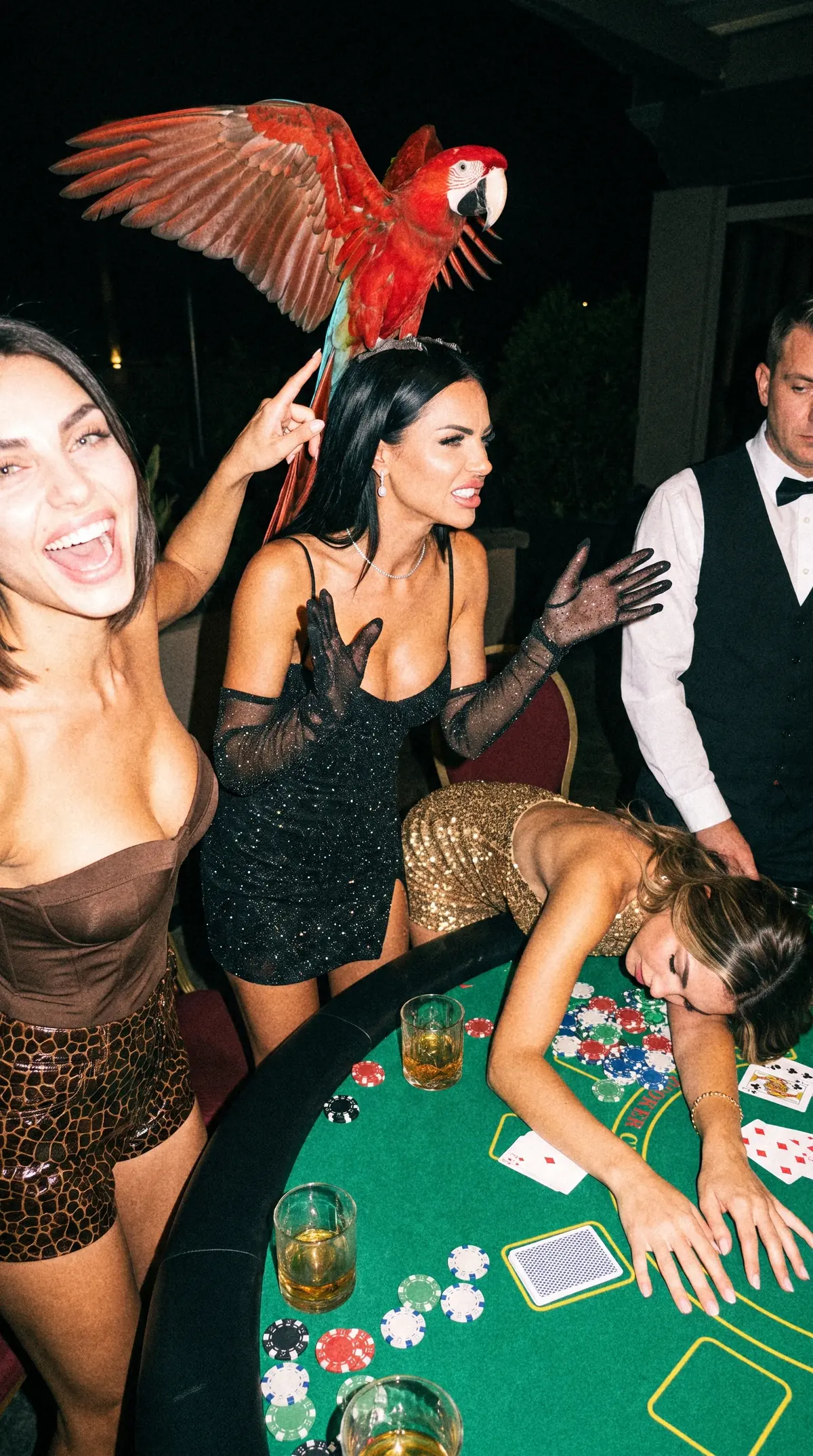
CAST — three specific people, locked to the reference images. image1 = Person 1 identity reference image2 = Person 1 outfit reference image3 = Person 2 identity reference image4 = Person 2 outfit reference image5 = Person 3 identity reference image6 = Person 3 outfit reference Person 1 = identity from image1 + outfit from image2 Person 2 = identity from image3 + outfit from image4 Person 3 = identity from image5 + outfit from image6 IDENTITY DISCIPLINE — THIS IS THE MOST COMMON FAILURE. AVOID IT. The three must read as three clearly different individuals. Copy each face from its own identity reference exactly: face shape, eyes, eyebrows, nose, mouth, skin tone, hair colour, hair length and hair style. Never blend two references into one face. Never give two people in this image the same face or the same hair — if two of them look alike, the image is wrong. Each outfit belongs to one person only: the clothing in image2 is worn ONLY by Person 1, the clothing in image4 ONLY by Person 2, the clothing in image6 ONLY by Person 3. Derive every garment only from that person's own outfit reference — exact pattern, exact texture, exact colour. Do not move a garment, a colour, a fabric or a print from one person to another, and do not invent a different outfit for anyone. Exactly three referenced people, each appearing exactly once. No fourth lookalike, no duplicate of anyone. THE MOMENT — a green felt card table on a casino floor at night, warm ceiling lights, marble pillars and rows of slot machines glowing behind. Chips in messy piles, playing cards face up on the felt, a glass ashtray with a burning cigarette, a half-drunk cocktail. A large scarlet macaw — red head and chest, green, yellow and blue wings, long red tail hanging almost to the floor — is perched directly on top of Person 2's head, feet gripping her hair, wings half open for balance. Person 2 is seated at the near left corner of the table in the foreground, leaning over her cards and studying them with her head down, holding two cards in one gloved hand and reaching for a chip with the other. She has not noticed the bird on her head at all. Person 1 is standing behind the table in the middle of the frame, bent forward over the rail, mouth wide open in disbelief, pointing straight at the parrot with one hand. Person 3 has collapsed on the far right side of the table: face down on the green felt, cheek flat on the cloth, hair spread out, both arms stretched across the table, laughing helplessly into the felt. Two male players in white shirts sit at the far side of the table watching, unimpressed. A stranger's hand and a stack of chips are cut off at the bottom edge of the frame. CAMERA A cheap 2009 pocket compact with direct on-camera flash, held low at table height. Harsh and unflattering: whatever is nearest the lens is slightly blown out and shiny, everything a few metres back drops away into dark, noisy murk. Ugly mixed white balance — warm casino light fighting cold flash, green in the shadows, magenta in the highlights. Visible sensor noise, JPEG mush in the dark areas, crunchy oversharpened edges. Skin keeps its texture and pores, but nobody has red blotches, rashes, broken veins, sunburn or red marks on the face — skin tone stays even and matches the identity reference. No smoothing, no gloss, no beauty retouch. Absolutely NO date stamp, NO timestamp, NO text, NO numbers and NO watermark anywhere in the frame. NOT A PHOTOSHOOT — THE MOST IMPORTANT COMPOSITION INSTRUCTION Nobody poses. No hand on hip, no weight shifted onto one leg, no chin tilt, nobody lined up side by side smiling into the lens, no one presenting themselves to the camera in any way. The photographer was not ready either. The horizon is tilted. Someone is cut off by the frame edge. Something is too close to the lens. At least one face is turned away or softened by movement. Bodies sit at random angles and different heights, overlapping. The result should read as a bad photograph of a real moment — not a good photograph of a staged one. If the image would work as an advertisement, it is wrong.
The Big Hand
06

The Big Hand

Blackjack · Chip towers · Phone on the felt

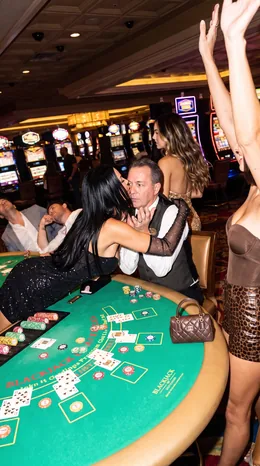
🃏 Blackjack Chips shoved across Handbag on the table
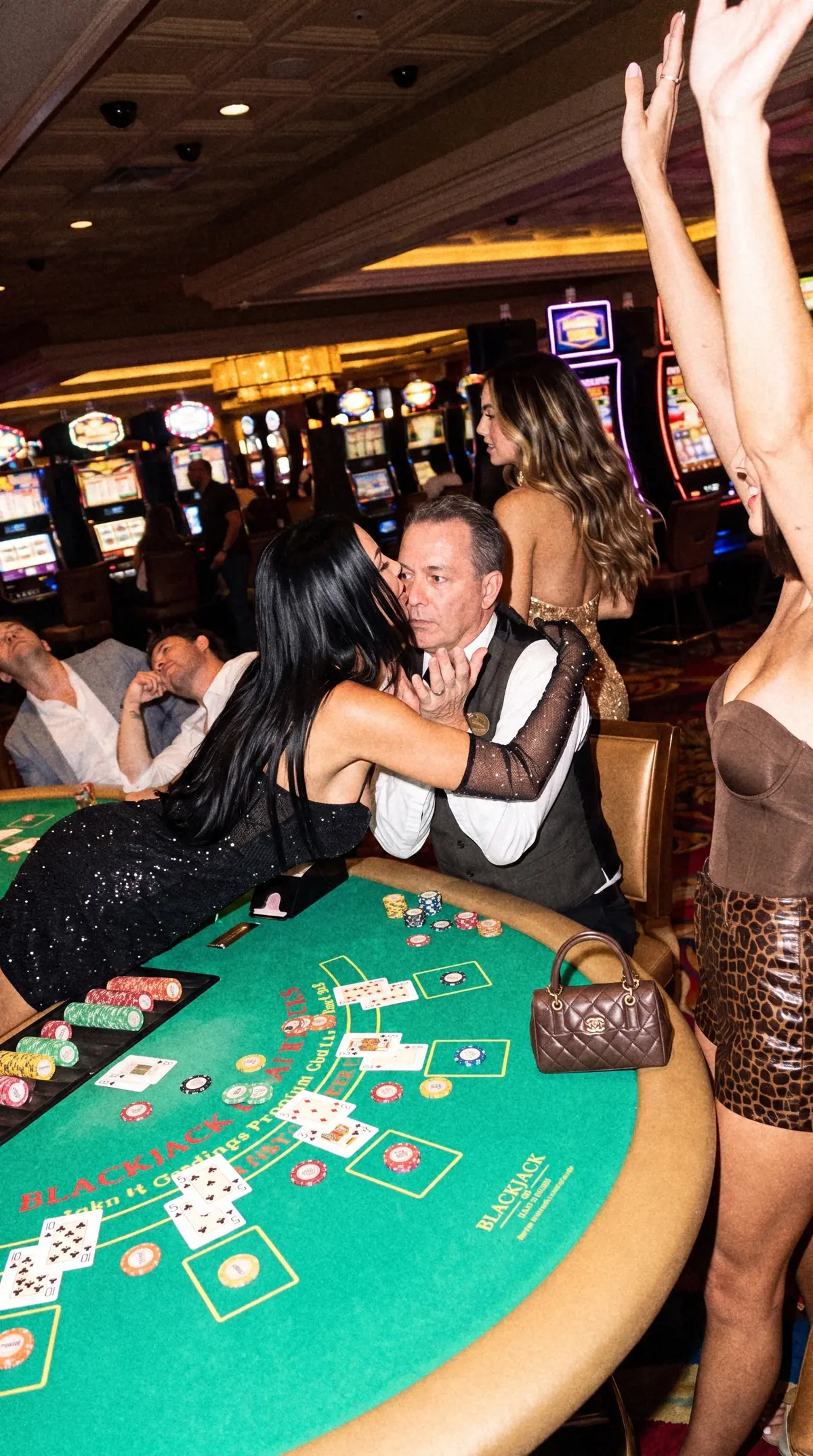
CAST — three specific people, locked to the reference images. image1 = Person 1 identity reference image2 = Person 1 outfit reference image3 = Person 2 identity reference image4 = Person 2 outfit reference image5 = Person 3 identity reference image6 = Person 3 outfit reference Person 1 = identity from image1 + outfit from image2 Person 2 = identity from image3 + outfit from image4 Person 3 = identity from image5 + outfit from image6 IDENTITY DISCIPLINE — THIS IS THE MOST COMMON FAILURE. AVOID IT. The three must read as three clearly different individuals. Copy each face from its own identity reference exactly: face shape, eyes, eyebrows, nose, mouth, skin tone, hair colour, hair length and hair style. Never blend two references into one face. Never give two people in this image the same face or the same hair — if two of them look alike, the image is wrong. Each outfit belongs to one person only: the clothing in image2 is worn ONLY by Person 1, the clothing in image4 ONLY by Person 2, the clothing in image6 ONLY by Person 3. Derive every garment only from that person's own outfit reference — exact pattern, exact texture, exact colour. Do not move a garment, a colour, a fabric or a print from one person to another, and do not invent a different outfit for anyone. Exactly three referenced people, each appearing exactly once. No fourth lookalike, no duplicate of anyone. THE MOMENT — a blackjack table on a busy casino floor, the moment a big hand has just come in. Towers of chips shoved across the green felt, cards face up, a handbag dumped on the table, a phone lying in the betting circle. Person 2 has thrown both arms around the seated dealer from the side and is kissing him hard on the cheek. He does not react at all: a middle-aged man in a waistcoat and white shirt staring straight ahead with a completely flat expression. Person 3 is standing right behind the dealer's chair, mouth open in a shout, leaning over his shoulder. Person 1 is at the right edge of the frame, cut off by it, both arms thrown straight up in the air — only her torso and raised arms are in frame, her face is out of shot above the top edge. Two men further down the table have fallen asleep on the felt, heads on their arms, ignoring everything. Slot machines glowing behind. CAMERA A cheap 2009 pocket compact with direct on-camera flash, held low at table height. Harsh and unflattering: whatever is nearest the lens is slightly blown out and shiny, everything a few metres back drops away into dark, noisy murk. Ugly mixed white balance — warm casino light fighting cold flash, green in the shadows, magenta in the highlights. Visible sensor noise, JPEG mush in the dark areas, crunchy oversharpened edges. Skin keeps its texture and pores, but nobody has red blotches, rashes, broken veins, sunburn or red marks on the face — skin tone stays even and matches the identity reference. No smoothing, no gloss, no beauty retouch. Absolutely NO date stamp, NO timestamp, NO text, NO numbers and NO watermark anywhere in the frame. NOT A PHOTOSHOOT — THE MOST IMPORTANT COMPOSITION INSTRUCTION Nobody poses. No hand on hip, no weight shifted onto one leg, no chin tilt, nobody lined up side by side smiling into the lens, no one presenting themselves to the camera in any way. The photographer was not ready either. The horizon is tilted. Someone is cut off by the frame edge. Something is too close to the lens. At least one face is turned away or softened by movement. Bodies sit at random angles and different heights, overlapping. The result should read as a bad photograph of a real moment — not a good photograph of a staged one. If the image would work as an advertisement, it is wrong.
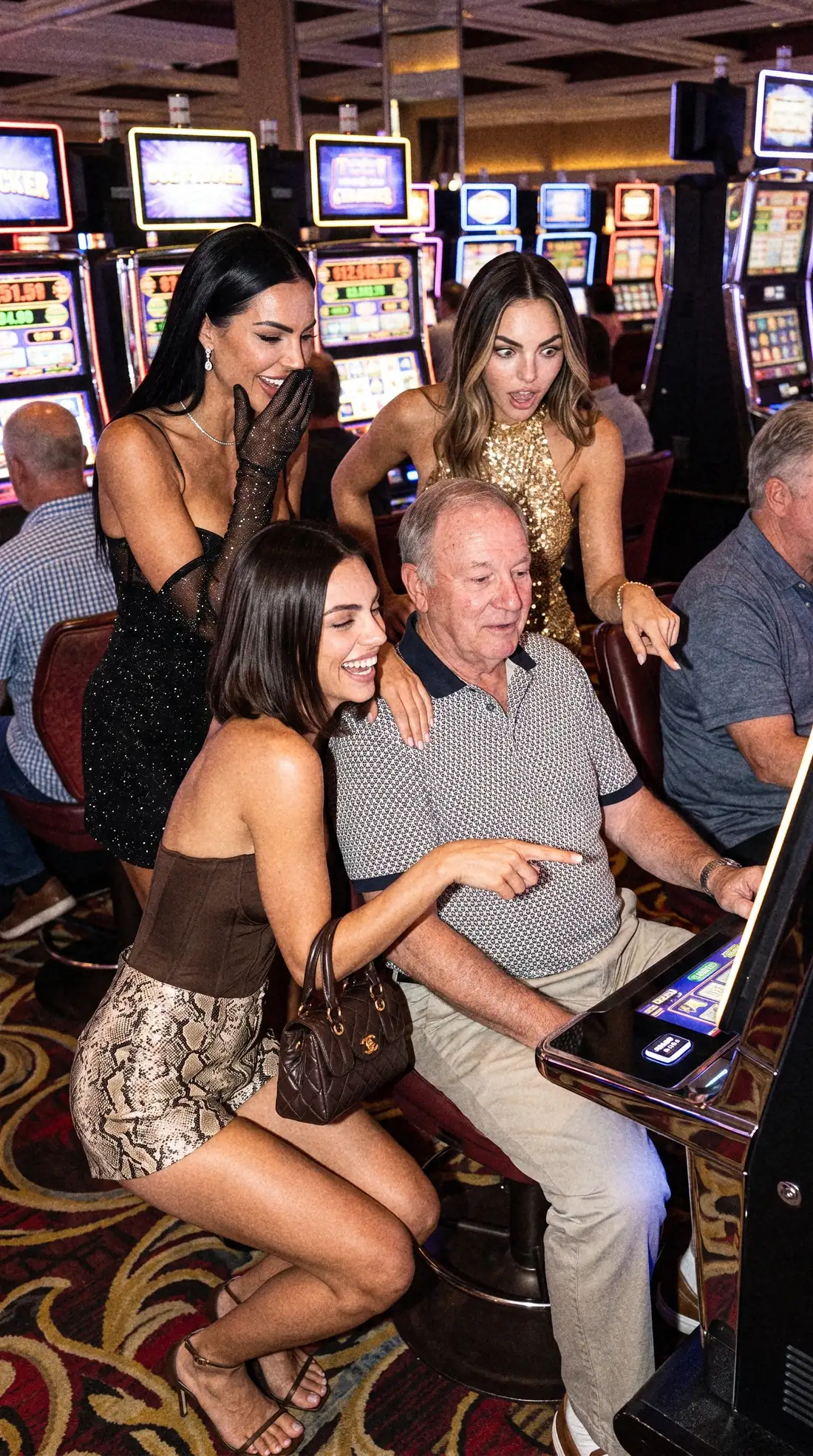
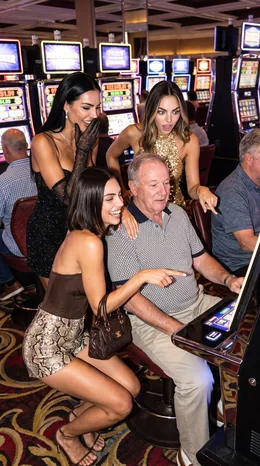
The Stranger at the Slots
07

The Stranger at the Slots

Slot row · Jackpot glow · One uninvited local

🎰 Slot machines Checked shirt stranger Jackpot displays
CAST — three specific people, locked to the reference images. image1 = Person 1 identity reference image2 = Person 1 outfit reference image3 = Person 2 identity reference image4 = Person 2 outfit reference image5 = Person 3 identity reference image6 = Person 3 outfit reference Person 1 = identity from image1 + outfit from image2 Person 2 = identity from image3 + outfit from image4 Person 3 = identity from image5 + outfit from image6 IDENTITY DISCIPLINE — THIS IS THE MOST COMMON FAILURE. AVOID IT. The three must read as three clearly different individuals. Copy each face from its own identity reference exactly: face shape, eyes, eyebrows, nose, mouth, skin tone, hair colour, hair length and hair style. Never blend two references into one face. Never give two people in this image the same face or the same hair — if two of them look alike, the image is wrong. Each outfit belongs to one person only: the clothing in image2 is worn ONLY by Person 1, the clothing in image4 ONLY by Person 2, the clothing in image6 ONLY by Person 3. Derive every garment only from that person's own outfit reference — exact pattern, exact texture, exact colour. Do not move a garment, a colour, a fabric or a print from one person to another, and do not invent a different outfit for anyone. Exactly three referenced people, each appearing exactly once. No fourth lookalike, no duplicate of anyone. THE MOMENT — a long row of slot machines on a casino floor, jackpot displays glowing above. An elderly man in a checked short-sleeved shirt is sitting on a stool at one machine, both hands on the buttons, staring at the screen. The three of them have adopted him. Person 1 has crouched right down beside his stool, very close to the lens, one hand on his shoulder and the other pointing at the screen, laughing with her eyes half shut. Person 2 is standing behind his other shoulder with a gloved hand clapped over her mouth, laughing. Person 3 is leaning over the back of his chair from behind, arm stretched past his head pointing at the screen, mouth wide open in shock. Other elderly players sit at the machines either side, completely oblivious. Patterned casino carpet underfoot. CAMERA A cheap 2009 pocket compact with direct on-camera flash. Harsh and unflattering: whatever is nearest the lens is slightly blown out and shiny, everything a few metres back drops away into dark, noisy murk. Ugly mixed white balance — warm casino light fighting cold flash, green in the shadows, magenta in the highlights. Visible sensor noise, JPEG mush in the dark areas, crunchy oversharpened edges. Skin keeps its texture and pores, but nobody has red blotches, rashes, broken veins, sunburn or red marks on the face — skin tone stays even and matches the identity reference. No smoothing, no gloss, no beauty retouch. Absolutely NO date stamp, NO timestamp, NO text, NO numbers and NO watermark anywhere in the frame. NOT A PHOTOSHOOT — THE MOST IMPORTANT COMPOSITION INSTRUCTION Nobody poses. No hand on hip, no weight shifted onto one leg, no chin tilt, nobody lined up side by side smiling into the lens, no one presenting themselves to the camera in any way. The photographer was not ready either. The horizon is tilted. Someone is cut off by the frame edge. Something is too close to the lens. At least one face is turned away or softened by movement. Bodies sit at random angles and different heights, overlapping. The result should read as a bad photograph of a real moment — not a good photograph of a staged one. If the image would work as an advertisement, it is wrong.
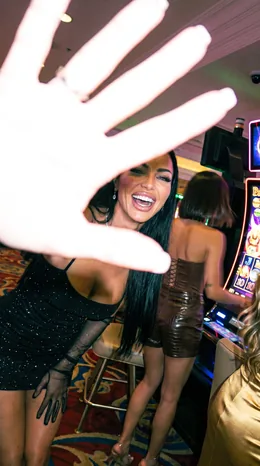
The Ruined Shot
08

The Ruined Shot

Palm over the lens · Blown to white · Ruined

✋ Hand blocking the flash Out of focus The bad one you keep
CAST — three specific people, locked to the reference images. image1 = Person 1 identity reference image2 = Person 1 outfit reference image3 = Person 2 identity reference image4 = Person 2 outfit reference image5 = Person 3 identity reference image6 = Person 3 outfit reference Person 1 = identity from image1 + outfit from image2 Person 2 = identity from image3 + outfit from image4 Person 3 = identity from image5 + outfit from image6 IDENTITY DISCIPLINE — THIS IS THE MOST COMMON FAILURE. AVOID IT. The three must read as three clearly different individuals. Copy each face from its own identity reference exactly: face shape, eyes, eyebrows, nose, mouth, skin tone, hair colour, hair length and hair style. Never blend two references into one face. Never give two people in this image the same face or the same hair — if two of them look alike, the image is wrong. Each outfit belongs to one person only: the clothing in image2 is worn ONLY by Person 1, the clothing in image4 ONLY by Person 2, the clothing in image6 ONLY by Person 3. Derive every garment only from that person's own outfit reference — exact pattern, exact texture, exact colour. Do not move a garment, a colour, a fabric or a print from one person to another, and do not invent a different outfit for anyone. Exactly three referenced people, each appearing exactly once. No fourth lookalike, no duplicate of anyone. THE MOMENT — the ruined shot of the night. Someone has thrown a hand up directly in front of the lens to block the flash: the palm fills almost half the frame, wildly out of focus, blown to pure white by the flash, fingers spread, the whole picture wrecked. Behind the hand, Person 2 is caught leaning into the camera laughing wide open with her head thrown forward, far too close, her face harshly lit and shiny. Person 1 has already turned her back and is walking out of frame to the right, only her shoulder and the back of her head in shot. Person 3 is a smeared blur of motion at the right edge, unrecognisable. Behind them, out of focus: slot machine screens, casino carpet, a stranger sitting at a bar stool. The whole frame is tilted hard to one side. CAMERA A cheap 2009 pocket compact with direct on-camera flash, fired by accident. Harsh and unflattering: whatever is nearest the lens is slightly blown out and shiny, everything a few metres back drops away into dark, noisy murk. Ugly mixed white balance — warm casino light fighting cold flash, green in the shadows, magenta in the highlights. Visible sensor noise, JPEG mush in the dark areas, crunchy oversharpened edges. Skin keeps its texture and pores, but nobody has red blotches, rashes, broken veins, sunburn or red marks on the face — skin tone stays even and matches the identity reference. No smoothing, no gloss, no beauty retouch. Absolutely NO date stamp, NO timestamp, NO text, NO numbers and NO watermark anywhere in the frame. NOT A PHOTOSHOOT — this is a genuinely bad photograph and it is meant to be. Nothing is composed, the focus is wrong, the exposure is wrong, the horizon is wrong. There is motion blur. Nobody is posing because nobody wanted this picture taken. A bad photograph of a real moment, not a good photograph of a staged one. If the image would work as an advertisement, it is wrong.
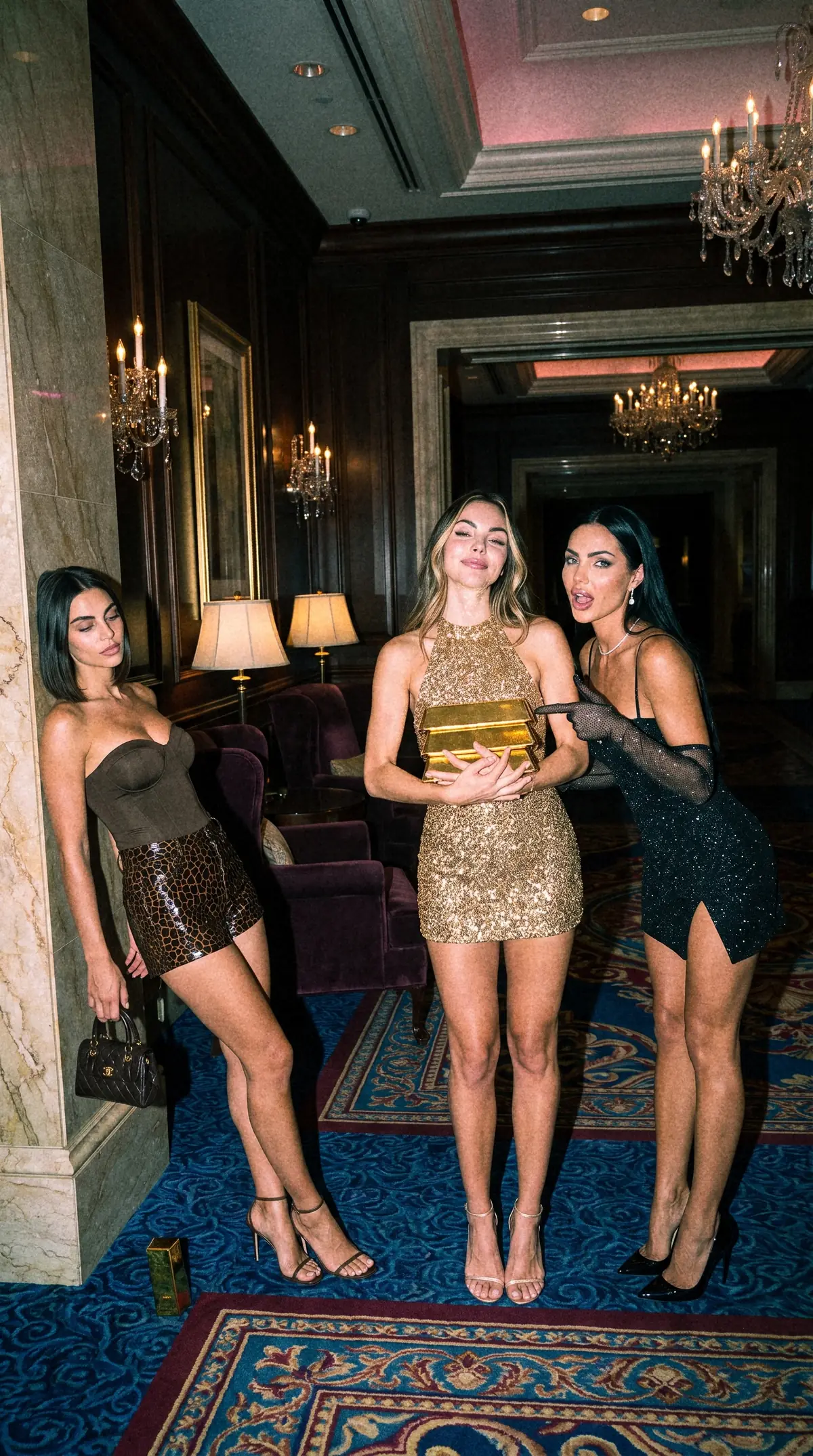
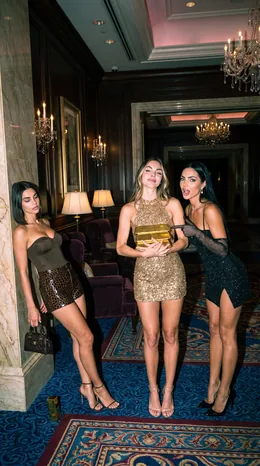
Gold Bars in the Lobby
09

Gold Bars in the Lobby

Gilded ceiling · Chandeliers · Marble pillar

🪙 Gold bars Velvet armchairs Late-night lobby
CAST — three specific people, locked to the reference images. image1 = Person 1 identity reference image2 = Person 1 outfit reference image3 = Person 2 identity reference image4 = Person 2 outfit reference image5 = Person 3 identity reference image6 = Person 3 outfit reference Person 1 = identity from image1 + outfit from image2 Person 2 = identity from image3 + outfit from image4 Person 3 = identity from image5 + outfit from image6 IDENTITY DISCIPLINE — THIS IS THE MOST COMMON FAILURE. AVOID IT. The three must read as three clearly different individuals. Copy each face from its own identity reference exactly: face shape, eyes, eyebrows, nose, mouth, skin tone, hair colour, hair length and hair style. Never blend two references into one face. Never give two people in this image the same face or the same hair — if two of them look alike, the image is wrong. Each outfit belongs to one person only: the clothing in image2 is worn ONLY by Person 1, the clothing in image4 ONLY by Person 2, the clothing in image6 ONLY by Person 3. Derive every garment only from that person's own outfit reference — exact pattern, exact texture, exact colour. Do not move a garment, a colour, a fabric or a print from one person to another, and do not invent a different outfit for anyone. Exactly three referenced people, each appearing exactly once. No fourth lookalike, no duplicate of anyone. WHO HOLDS THE GOLD — READ THIS TWICE BEFORE DRAWING. The stack of gold bars belongs to PERSON 3 (image5 + image6). Person 3 and only Person 3 holds the stack. PERSON 1 (image1 + image2) does NOT hold the stack and is NOT in the centre — she is slumped against the pillar at the left edge. THE MOMENT — the grand lobby of an opulent Las Vegas casino hotel late at night. Coffered gilded ceiling, two crystal chandeliers, a tall polished marble pillar at the left edge of the frame, deep plum and burgundy velvet armchairs, table lamps, an ornate blue and red patterned carpet, a corridor receding into warm darkness. All three stand across the middle of the frame, full length, shot from slightly below. Centre: PERSON 3 (image5 + image6) holding a stack of three heavy gold bullion bars with both hands against her chest, stamped serial numbers catching the light. Enormously proud — chin lifted, slow satisfied smile — but her eyes are glassy and half focused and she sways slightly off balance. Obviously already drunk. Right of her: PERSON 2 (image3 + image4), leaning in towards the gold and pointing straight at the bars with one gloved hand raised in front of her, eyebrows up, mouth open mid-sentence, looking at whoever holds the camera. Left edge at the marble pillar: PERSON 1 (image1 + image2), propped sideways against the cold stone with her shoulder and the side of her head, one arm hanging, a single loose gold bar dangling from her fingers, eyes half closed, chin dropped, barely upright. CAMERA A cheap 2009 pocket compact with direct on-camera flash. Harsh and unflattering: whatever is nearest the lens is slightly blown out and shiny, everything a few metres back drops away into dark, noisy murk. Ugly mixed white balance — warm lobby tungsten fighting cold flash, green in the shadows, magenta in the highlights. Visible sensor noise, JPEG mush in the dark areas, crunchy oversharpened edges. Skin keeps its texture and pores, but nobody has red blotches, rashes, broken veins, sunburn or red marks on the face — skin tone stays even and matches the identity reference. No smoothing, no gloss, no beauty retouch. Absolutely NO date stamp, NO timestamp, NO text and NO watermark anywhere in the frame apart from the serial numbers stamped into the gold bars. NOT A PHOTOSHOOT — nobody is modelling. No hand on hip, no weight shifted for effect, no chin tilt for the lens. The horizon is slightly tilted, the pillar cuts into the left edge, the framing is a little too low and a little too wide. Two of the three are not looking at the camera. A bad photograph of a real moment, not a good photograph of a staged one. If the image would work as an advertisement, it is wrong.
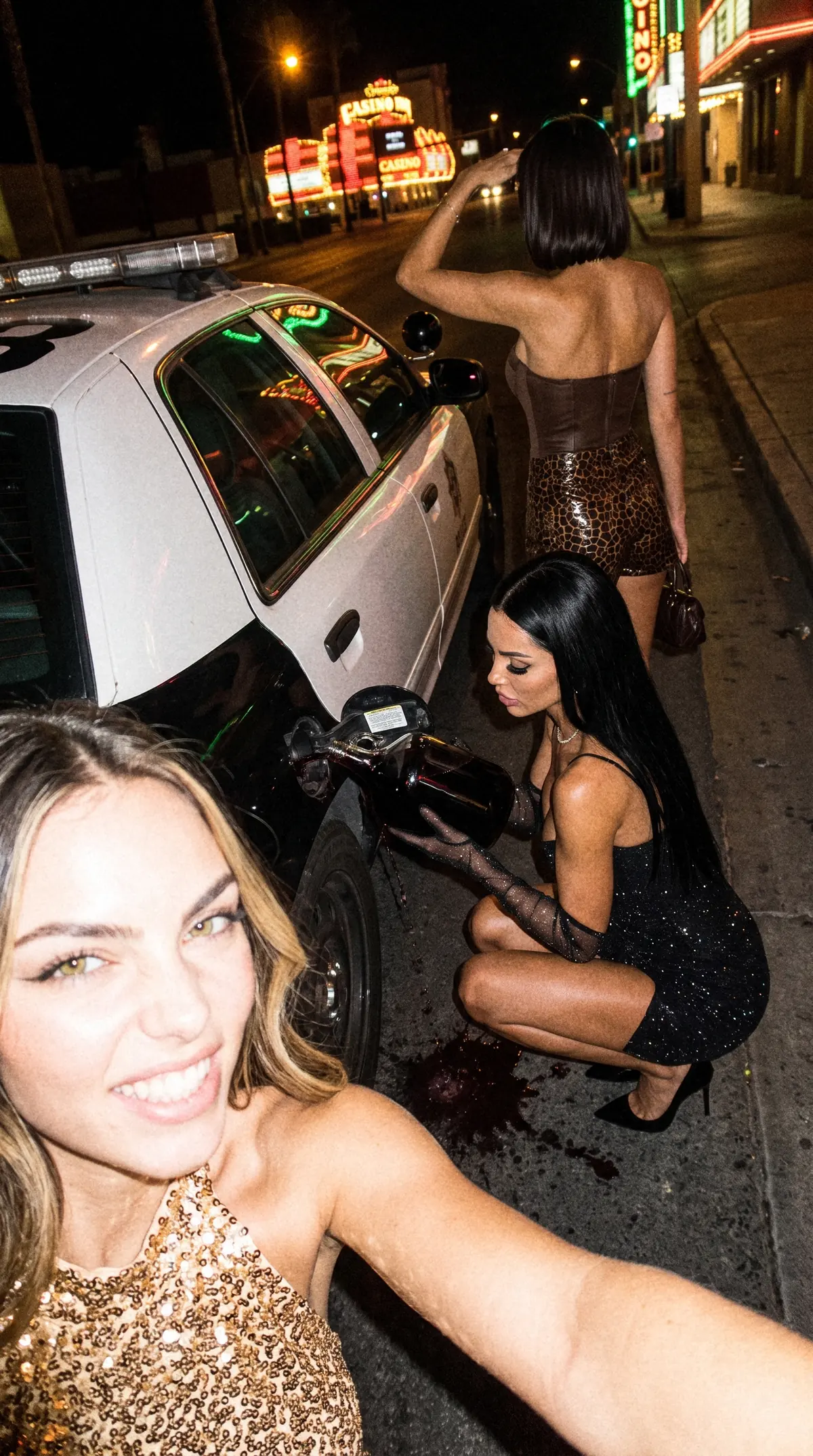
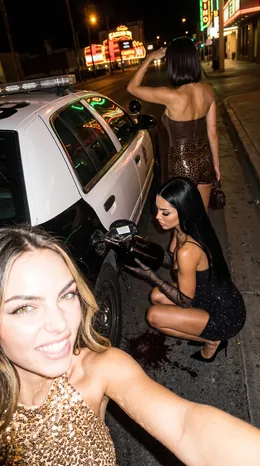
Wine into the Police Van
10

Wine into the Police Van

Selfie at arm’s length · Police cruiser · Neon

🚔 Police cruiser Selfie at arm’s length Side street
CAST — three specific people, locked to the reference images. image1 = Person 1 identity reference image2 = Person 1 outfit reference image3 = Person 2 identity reference image4 = Person 2 outfit reference image5 = Person 3 identity reference image6 = Person 3 outfit reference Person 1 = identity from image1 + outfit from image2 Person 2 = identity from image3 + outfit from image4 Person 3 = identity from image5 + outfit from image6 IDENTITY DISCIPLINE — THIS IS THE MOST COMMON FAILURE. AVOID IT. The three must read as three clearly different individuals. Copy each face from its own identity reference exactly: face shape, eyes, eyebrows, nose, mouth, skin tone, hair colour, hair length and hair style. Never blend two references into one face. Never give two people in this image the same face or the same hair — if two of them look alike, the image is wrong. Each outfit belongs to one person only: the clothing in image2 is worn ONLY by Person 1, the clothing in image4 ONLY by Person 2, the clothing in image6 ONLY by Person 3. Derive every garment only from that person's own outfit reference — exact pattern, exact texture, exact colour. Do not move a garment, a colour, a fabric or a print from one person to another, and do not invent a different outfit for anyone. Exactly three referenced people, each appearing exactly once. No fourth lookalike, no duplicate of anyone. WHO IS WHERE — READ THIS TWICE BEFORE DRAWING. PERSON 3 (image5 + image6) is the one holding the camera and taking the selfie, closest to the lens. PERSON 2 (image3 + image4) is the one crouched at the police car pouring the wine into the fuel filler. PERSON 1 (image1 + image2) is the one standing guard, looking away down the street. THE MOMENT — a handheld selfie taken at arm's length on a Las Vegas side street at night, a parked white and black police cruiser right behind them, casino neon burning out of focus further down the road. PERSON 3 is holding the camera herself: her face fills the near part of the frame, far too close, distorted by the wide lens and blown out by the flash, grinning conspiratorially with one eyebrow raised, her outstretched arm running along the bottom edge of the frame. Behind her, crouched at the open fuel filler of the police car, PERSON 2 is tipping a big glass demijohn of dark homemade red wine into the tank with both gloved hands, wine slopping down the white paintwork and pooling on the asphalt. PERSON 1 stands beside the car keeping watch, turned away from the camera, looking off down the street with one hand raised to shield her eyes from the neon. CAMERA A cheap 2009 pocket compact with direct on-camera flash, held at arm's length. Harsh and unflattering: whatever is nearest the lens is slightly blown out and shiny, everything a few metres back drops away into dark, noisy murk. Ugly mixed white balance — warm neon fighting cold flash, green in the shadows, magenta in the highlights. Visible sensor noise, JPEG mush in the dark areas, crunchy oversharpened edges. Skin keeps its texture and pores, but nobody has red blotches, rashes, broken veins, sunburn or red marks on the face — skin tone stays even and matches the identity reference. No smoothing, no gloss, no beauty retouch. Absolutely NO date stamp, NO timestamp, NO text, NO numbers and NO watermark anywhere in the frame. NOT A PHOTOSHOOT — badly framed, tilted, the selfie arm in shot, one head half cut off by the top edge. Nobody but the selfie-taker knows the picture is happening. A bad photograph of a real moment, not a good photograph of a staged one. If the image would work as an advertisement, it is wrong.
Karaoke
11

Karaoke

Private room · Blue lyrics · One magenta light

🎤 Microphone Karaoke screen Bare concrete room
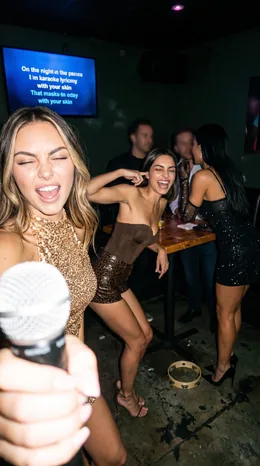
CAST — three specific people, locked to the reference images. image1 = Person 1 identity reference image2 = Person 1 outfit reference image3 = Person 2 identity reference image4 = Person 2 outfit reference image5 = Person 3 identity reference image6 = Person 3 outfit reference Person 1 = identity from image1 + outfit from image2 Person 2 = identity from image3 + outfit from image4 Person 3 = identity from image5 + outfit from image6 IDENTITY DISCIPLINE — THIS IS THE MOST COMMON FAILURE. AVOID IT. The three must read as three clearly different individuals. Copy each face from its own identity reference exactly: face shape, eyes, eyebrows, nose, mouth, skin tone, hair colour, hair length and hair style. Never blend two references into one face. Never give two people in this image the same face or the same hair — if two of them look alike, the image is wrong. Each outfit belongs to one person only: the clothing in image2 is worn ONLY by Person 1, the clothing in image4 ONLY by Person 2, the clothing in image6 ONLY by Person 3. Derive every garment only from that person's own outfit reference — exact pattern, exact texture, exact colour. Do not move a garment, a colour, a fabric or a print from one person to another, and do not invent a different outfit for anyone. Exactly three referenced people, each appearing exactly once. No fourth lookalike, no duplicate of anyone. THE MOMENT — a dark private karaoke room, bare concrete floor, a wall-mounted flat screen showing blue karaoke lyrics, a single magenta ceiling light, a scuffed wooden high table with drinks and a phone on it. Person 3 is closest to the lens, thrusting a microphone out towards the camera at arm's length, eyes screwed shut, mouth wide open, singing at full volume. Her face and the microphone are harshly blown out by the flash. Person 1 is behind her mid-dance move, doubled over with one arm bent up, laughing so hard her eyes are shut, caught off balance mid-step. Person 2 is further back at the high table with her back turned to the camera, talking to two male strangers, completely uninvolved. A tambourine lying abandoned on the floor, a stain on the concrete. CAMERA A cheap 2009 pocket compact with direct on-camera flash. Harsh and unflattering: whatever is nearest the lens is slightly blown out and shiny, everything a few metres back drops away into dark, noisy murk. Ugly mixed white balance — magenta room light fighting cold flash, green in the shadows. Visible sensor noise, JPEG mush in the dark areas, crunchy oversharpened edges. Skin keeps its texture and pores, but nobody has red blotches, rashes, broken veins, sunburn or red marks on the face — skin tone stays even and matches the identity reference. No smoothing, no gloss, no beauty retouch. Absolutely NO date stamp, NO timestamp and NO watermark anywhere in the frame. The only readable text is the karaoke lyrics on the screen. NOT A PHOTOSHOOT — nobody poses. The microphone is far too close to the lens, the horizon is tilted, one person is turned completely away, nobody is arranged for the picture. A bad photograph of a real moment, not a good photograph of a staged one. If the image would work as an advertisement, it is wrong.
Club with the Gold
12

Club with the Gold

Mirrored stage · Chrome pole · Sparklers

✨ Bottle service Thirty guests Magenta LEDs
CAST — three specific people, locked to the reference images. image1 = Person 1 identity reference image2 = Person 1 outfit reference image3 = Person 2 identity reference image4 = Person 2 outfit reference image5 = Person 3 identity reference image6 = Person 3 outfit reference Person 1 = identity from image1 + outfit from image2 Person 2 = identity from image3 + outfit from image4 Person 3 = identity from image5 + outfit from image6 IDENTITY DISCIPLINE — THIS IS THE MOST COMMON FAILURE. AVOID IT. The three must read as three clearly different individuals. Copy each face from its own identity reference exactly: face shape, eyes, eyebrows, nose, mouth, skin tone, hair colour, hair length and hair style. Never blend two references into one face. Never give two people in this image the same face or the same hair — if two of them look alike, the image is wrong. Each outfit belongs to one person only: the clothing in image2 is worn ONLY by Person 1, the clothing in image4 ONLY by Person 2, the clothing in image6 ONLY by Person 3. Derive every garment only from that person's own outfit reference — exact pattern, exact texture, exact colour. Do not move a garment, a colour, a fabric or a print from one person to another, and do not invent a different outfit for anyone. Exactly three referenced people, each appearing exactly once. No fourth lookalike, no duplicate of anyone. THE MOMENT — a packed modern upscale nightclub with a round mirrored stage and a chrome pole, magenta and violet LED strips, mirrored walls, backlit bottle shelves, bottle service tables with sparklers. The club is FULL: thirty or more guests, a dense crowd pressed around the stage rail with drinks and phones up, more people at the tables behind, waitresses squeezing through, two security men in dark suits at the edge. On the stage Person 1 has one hand high on the pole and is leaning her weight out and back off it, hair swung across her face, one knee hooked in. Person 2 is beside her arched backwards from the waist with her hair hanging down, one arm trailing. Person 3 is at the front edge of the stage flinging heavy gold bullion bars out over the crowd with a big underarm sweep, the way people throw banknotes — three or four gold bars caught mid-air, several more lying on the mirrored floor. Guests ducking and grabbing for them. All three remain fully clothed in their reference outfits throughout. Nothing explicit, no nudity, no undressing, suitable for a general audience. CAMERA A cheap 2009 pocket compact with direct on-camera flash, shot from inside the crowd. Harsh and unflattering: whatever is nearest the lens is slightly blown out and shiny, everything a few metres back drops away into dark, noisy murk. Ugly mixed white balance — magenta LED fighting cold flash, green in the shadows. Visible sensor noise, JPEG mush in the dark areas, crunchy oversharpened edges. Skin keeps its texture and pores, but nobody has red blotches, rashes, broken veins, sunburn or red marks on the face — skin tone stays even and matches the identity reference. No smoothing, no gloss, no beauty retouch. Absolutely NO date stamp, NO timestamp, NO text, NO numbers and NO watermark anywhere in the frame. NOT A PHOTOSHOOT — shot over shoulders and past heads from inside the crowd, tilted, one stranger's arm blurred across the near corner. Nobody on the stage is presenting themselves to this camera; they do not know it exists. A bad photograph of a real moment, not a good photograph of a staged one. If the image would work as an advertisement, it is wrong.
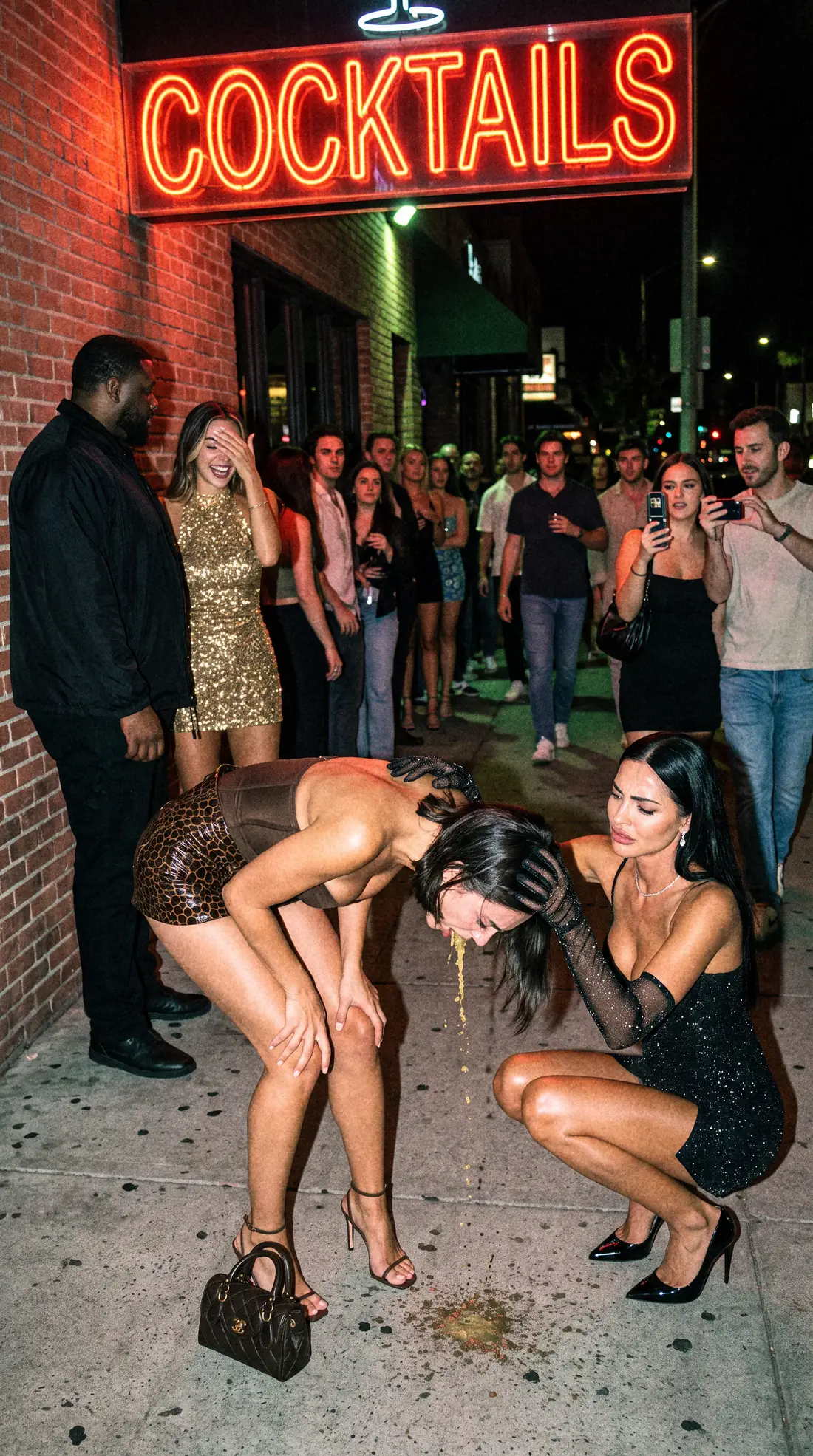
Under the COCKTAILS Sign
13

Under the COCKTAILS Sign

Pavement · Red neon · Twenty strangers watching

🍸 Red neon sign Friday night queue Nobody helps
CAST — three specific people, locked to the reference images. image1 = Person 1 identity reference image2 = Person 1 outfit reference image3 = Person 2 identity reference image4 = Person 2 outfit reference image5 = Person 3 identity reference image6 = Person 3 outfit reference Person 1 = identity from image1 + outfit from image2 Person 2 = identity from image3 + outfit from image4 Person 3 = identity from image5 + outfit from image6 IDENTITY DISCIPLINE — THIS IS THE MOST COMMON FAILURE. AVOID IT. The three must read as three clearly different individuals. Copy each face from its own identity reference exactly: face shape, eyes, eyebrows, nose, mouth, skin tone, hair colour, hair length and hair style. Never blend two references into one face. Never give two people in this image the same face or the same hair — if two of them look alike, the image is wrong. Each outfit belongs to one person only: the clothing in image2 is worn ONLY by Person 1, the clothing in image4 ONLY by Person 2, the clothing in image6 ONLY by Person 3. Derive every garment only from that person's own outfit reference — exact pattern, exact texture, exact colour. Do not move a garment, a colour, a fabric or a print from one person to another, and do not invent a different outfit for anyone. Exactly three referenced people, each appearing exactly once. No fourth lookalike, no duplicate of anyone. WHO IS WHERE — READ THIS TWICE BEFORE DRAWING. PERSON 1 (image1 + image2) is the one being sick. PERSON 2 (image3 + image4) is the one crouched beside her holding her hair. PERSON 3 (image5 + image6) is the one standing further back by the wall next to the bouncer — built from image5 and image6, and she must look nothing like Person 2. THE MOMENT — the pavement outside a bar under a big red neon COCKTAILS sign, a busy Friday night. The street is full of strangers: a queue along the wall, groups walking past, a couple filming on a flip phone, twenty or more people. PERSON 1 is bent forward at the waist in the middle of the pavement being violently sick onto the concrete, hands braced on her knees, hair falling forward. PERSON 2 is right beside her, crouched in close, one gloved hand holding Person 1's hair back and the other flat on her back, face screwed up in sympathy and turned away from the mess. PERSON 3 is further back near the wall, standing next to a large bouncer in a black SECURITY jacket, one hand over her face laughing, clearly explaining something to him. Passers-by stepping around the puddle, wet pavement reflecting the red neon. CAMERA A cheap 2009 pocket compact with direct on-camera flash. Harsh and unflattering: whatever is nearest the lens is slightly blown out and shiny, everything a few metres back drops away into dark, noisy murk. Ugly mixed white balance — red neon fighting cold flash, green in the shadows, magenta in the highlights. Visible sensor noise, JPEG mush in the dark areas, crunchy oversharpened edges. Skin keeps its texture and pores, but nobody has red blotches, rashes, broken veins, sunburn or red marks on the face — skin tone stays even and matches the identity reference. No smoothing, no gloss, no beauty retouch. Absolutely NO date stamp, NO timestamp and NO watermark anywhere in the frame. The only readable text is the neon sign and the word on the bouncer's jacket. NOT A PHOTOSHOOT — THE MOST IMPORTANT COMPOSITION INSTRUCTION Nobody poses. No hand on hip, no weight shifted onto one leg, no chin tilt, nobody lined up side by side smiling into the lens, no one presenting themselves to the camera in any way. The photographer was not ready either. The horizon is tilted. Someone is cut off by the frame edge. Something is too close to the lens. At least one face is turned away or softened by movement. Bodies sit at random angles and different heights, overlapping. The result should read as a bad photograph of a real moment — not a good photograph of a staged one. If the image would work as an advertisement, it is wrong.
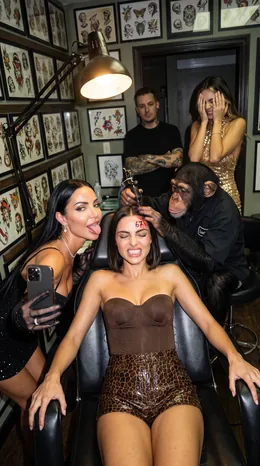
The Chimp Tattoos the 67
14

The Chimp Tattoos the 67

Tattoo studio · Half-finished ink · Nobody looks

🐵 Chimpanzee artist 67 in progress Flash art walls
CAST — three specific people, locked to the reference images. image1 = Person 1 identity reference image2 = Person 1 outfit reference image3 = Person 2 identity reference image4 = Person 2 outfit reference image5 = Person 3 identity reference image6 = Person 3 outfit reference Person 1 = identity from image1 + outfit from image2 Person 2 = identity from image3 + outfit from image4 Person 3 = identity from image5 + outfit from image6 IDENTITY DISCIPLINE — THIS IS THE MOST COMMON FAILURE. AVOID IT. The three must read as three clearly different individuals. Copy each face from its own identity reference exactly: face shape, eyes, eyebrows, nose, mouth, skin tone, hair colour, hair length and hair style. Never blend two references into one face. Never give two people in this image the same face or the same hair — if two of them look alike, the image is wrong. Each outfit belongs to one person only: the clothing in image2 is worn ONLY by Person 1, the clothing in image4 ONLY by Person 2, the clothing in image6 ONLY by Person 3. Derive every garment only from that person's own outfit reference — exact pattern, exact texture, exact colour. Do not move a garment, a colour, a fabric or a print from one person to another, and do not invent a different outfit for anyone. Exactly three referenced people, each appearing exactly once. No fourth lookalike, no duplicate of anyone. THE TATTOO — IN PROGRESS, THIS IS THE MOMENT IT IS MADE. SIDE IS CRITICAL. A small crooked hand-poked number 67 in black ink is being tattooed onto Person 1's forehead above ONE eyebrow, near the hairline. It must sit above her LEFT eyebrow — her own left, the same side as her left eye and her left hand. She is facing towards the camera, so the 67 must appear on the RIGHT half of the image, to the right of her nose from the viewer's point of view. CHECK: if the 67 ends up on the LEFT half of the image, it is on the wrong side — mirror it across to the other eyebrow. The tattoo is only HALF FINISHED: raw, reddened, partly outlined, with a smear of ink and a wipe of blood around it. Nowhere else on her face. Persons 2 and 3 have no facial tattoo. WHO IS WHERE — READ THIS TWICE BEFORE DRAWING. PERSON 1 (image1 + image2) is the one in the tattoo chair being tattooed. PERSON 2 (image3 + image4) is the one taking the selfie. PERSON 3 (image5 + image6) is the one hiding her face against the wall. THE MOMENT — a small tattoo studio at night, framed flash art covering the walls, a neon sign, an anglepoise lamp swung in close, a steel tray of needles and a squeeze bottle in the foreground. A young chimpanzee wearing a black work shirt sits on the artist's stool leaning over Person 1, gripping a tattoo machine in one gloved hand and steadying her head with the other, actually working on her forehead. Person 1 is tipped back in the reclined black leather chair, both hands clamped on the armrests, eyes screwed shut, teeth bared. Person 2 leans in from the side holding a phone out at arm's length taking a selfie of the whole scene, tongue out, not looking at the screen. Person 3 stands back against the wall with both hands over her face, cringing, deliberately not looking at the camera. A bored human tattoo artist stands behind with his arms folded. CAMERA A cheap 2009 pocket compact with direct on-camera flash. Harsh and unflattering: whatever is nearest the lens is slightly blown out and shiny, everything a few metres back drops away into dark, noisy murk. Ugly mixed white balance — warm studio light fighting cold flash, green in the shadows, magenta in the highlights. Visible sensor noise, JPEG mush in the dark areas, crunchy oversharpened edges. Skin keeps its texture and pores, but nobody has red blotches, rashes, broken veins, sunburn or red marks on the face — skin tone stays even and matches the identity reference. No smoothing, no gloss, no beauty retouch. Absolutely NO date stamp, NO timestamp and NO watermark anywhere in the frame. The only number in the image is the half-finished 67 on the forehead. NOT A PHOTOSHOOT — nobody poses for this camera, the horizon is tilted, the instrument tray is too close to the lens, at least one face is hidden. A bad photograph of a real moment, not a good photograph of a staged one. If the image would work as an advertisement, it is wrong.
Lifting the Lion
15

Lifting the Lion

Zoo service yard · Big cat house · Floodlight

🦁 The lion 67 tattoo done Chain-link and straw
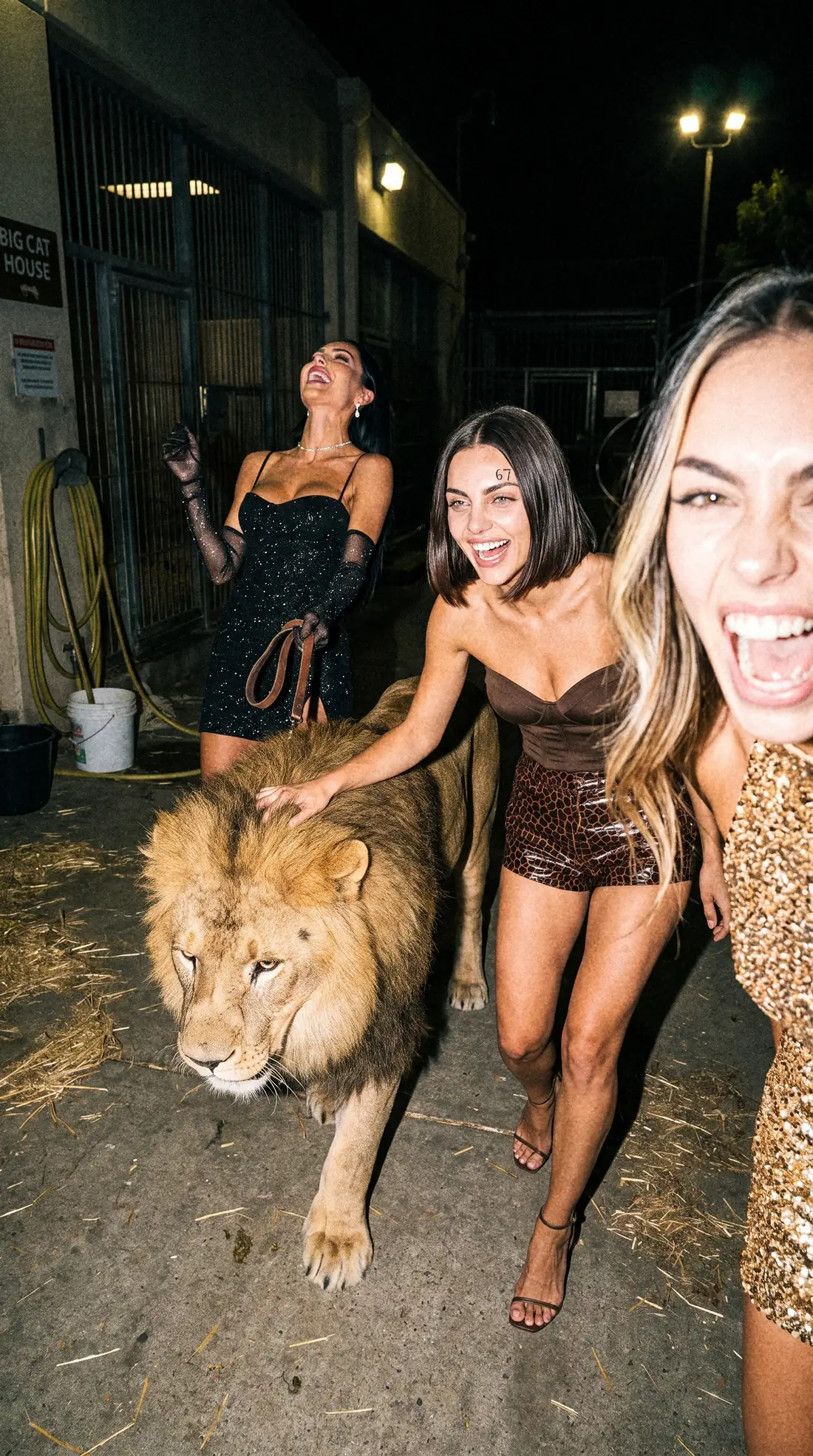
CAST — three specific people, locked to the reference images. image1 = Person 1 identity reference image2 = Person 1 outfit reference image3 = Person 2 identity reference image4 = Person 2 outfit reference image5 = Person 3 identity reference image6 = Person 3 outfit reference Person 1 = identity from image1 + outfit from image2 Person 2 = identity from image3 + outfit from image4 Person 3 = identity from image5 + outfit from image6 IDENTITY DISCIPLINE — THIS IS THE MOST COMMON FAILURE. AVOID IT. The three must read as three clearly different individuals. Copy each face from its own identity reference exactly: face shape, eyes, eyebrows, nose, mouth, skin tone, hair colour, hair length and hair style. Never blend two references into one face. Never give two people in this image the same face or the same hair — if two of them look alike, the image is wrong. Each outfit belongs to one person only: the clothing in image2 is worn ONLY by Person 1, the clothing in image4 ONLY by Person 2, the clothing in image6 ONLY by Person 3. Derive every garment only from that person's own outfit reference — exact pattern, exact texture, exact colour. Do not move a garment, a colour, a fabric or a print from one person to another, and do not invent a different outfit for anyone. Exactly three referenced people, each appearing exactly once. No fourth lookalike, no duplicate of anyone. THE TATTOO — SIDE IS CRITICAL. A small crooked hand-poked number 67 in black ink sits on Person 1's forehead above her LEFT eyebrow — her own left, the same side as her left eye and left hand — close to the hairline. Facing the camera this places it on the RIGHT half of the image, to the right of her nose from the viewer's point of view. If it ends up on the left half of the image, mirror it to the other eyebrow. It is a small clean black number and nothing else — no extra marks, no red patches, no scratches. Persons 2 and 3 have no facial tattoo. THE LION must be photographically real: correct anatomy and scale for a full-grown male lion, individual fur strands, real weight resting on the surface, lit by exactly the same flash and ambient light as the people, casting matching shadows, with matching grain and sharpness. Not a cut-out, not pasted in, not a plush toy, not a flat sticker. WHO IS WHERE — READ THIS TWICE BEFORE DRAWING. PERSON 2 (image3 + image4) leads the lion out on the leash. PERSON 3 (image5 + image6) is the one filming on the phone, nearest the lens — she must look nothing like Person 2. PERSON 1 (image1 + image2) walks beside the lion with a hand in its mane. THE MOMENT — the back service area of a proper zoo at night. Barred animal enclosures with painted species information boards, a large BIG CAT HOUSE sign, chain-link runs, coiled hosepipes, feed buckets, straw on the concrete, a floodlight on a pole, a keeper's quad bike parked to one side. PERSON 2 walks the lion out through the open enclosure gate on a slack leather leash, leaning back against its weight, laughing helplessly with her head thrown back. PERSON 1 walks alongside the lion laughing too, one hand buried in its mane, staggering, obviously very drunk. PERSON 3 is closest to the lens filming on a modern smartphone held vertically, only half her face visible past the phone, screaming with laughter. All three are drunk — smudged eye makeup, unsteady, hair coming loose. CAMERA A cheap 2009 pocket compact with direct on-camera flash. Harsh and unflattering: whatever is nearest the lens is slightly blown out and shiny, everything a few metres back drops away into dark, noisy murk. Ugly mixed white balance — sodium floodlight fighting cold flash, green in the shadows, magenta in the highlights. Visible sensor noise, JPEG mush in the dark areas, crunchy oversharpened edges. Skin keeps its texture and pores, but nobody has red blotches, rashes, broken veins, sunburn or red marks on the face — skin tone stays even and matches the identity reference. No smoothing, no gloss, no beauty retouch. Absolutely NO date stamp, NO timestamp, NO text, NO numbers and NO watermark anywhere in the frame. NOT A PHOTOSHOOT — nobody poses, the horizon is tilted, someone is cut off by the frame edge, at least one face is softened by movement. A bad photograph of a real moment, not a good photograph of a staged one. If the image would work as an advertisement, it is wrong.
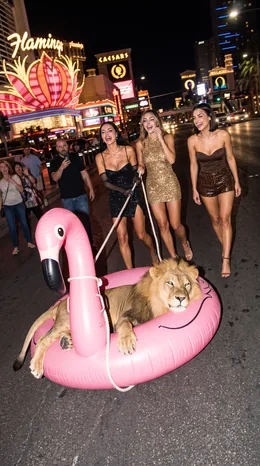
Lion on the Flamingo
16

Lion on the Flamingo

Neon boulevard · Wet road · Pink pool float

🦁 Lion on a float 🦅 Flamingo ring Marquee lights
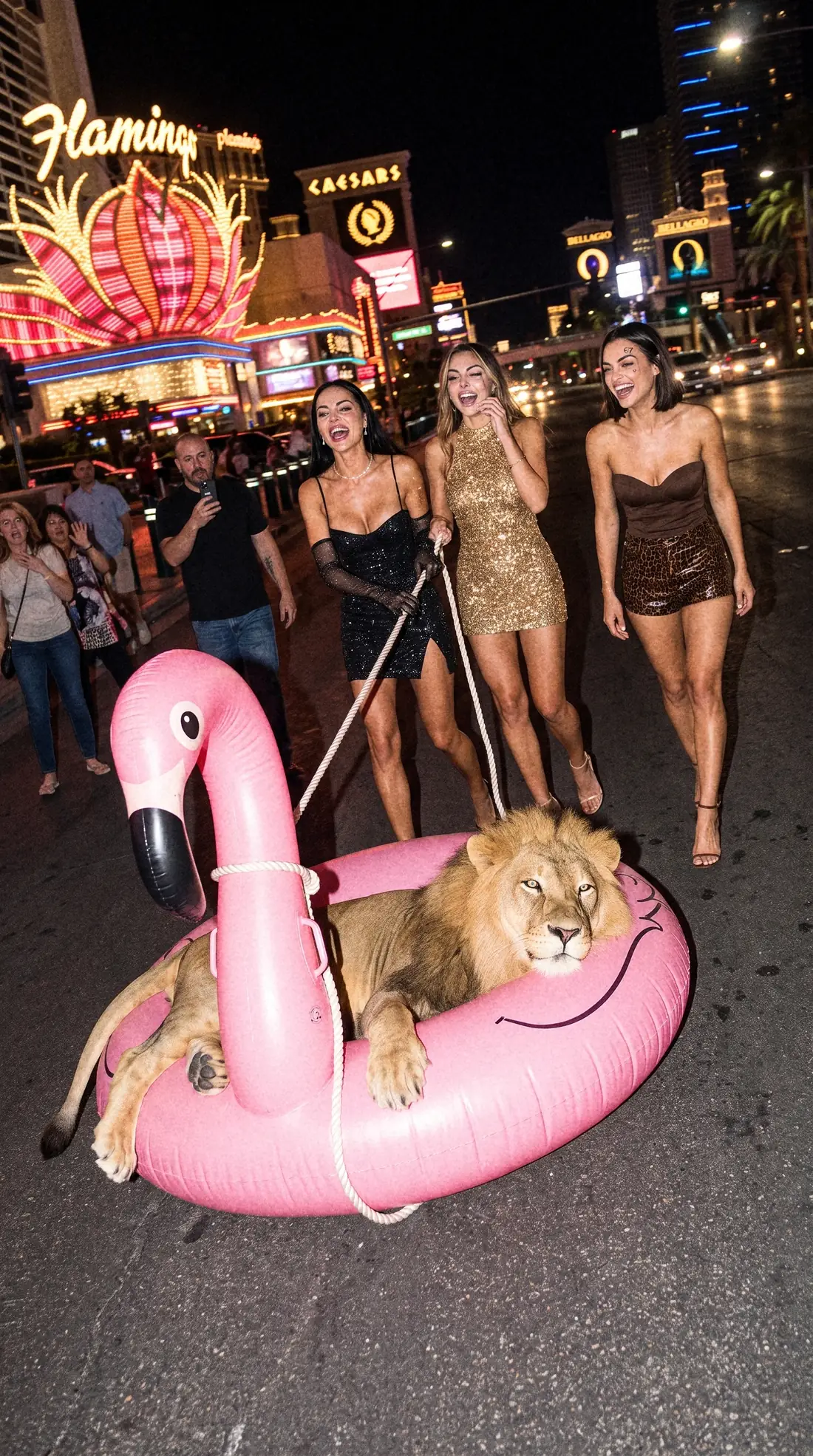
CAST — three specific people, locked to the reference images. image1 = Person 1 identity reference image2 = Person 1 outfit reference image3 = Person 2 identity reference image4 = Person 2 outfit reference image5 = Person 3 identity reference image6 = Person 3 outfit reference Person 1 = identity from image1 + outfit from image2 Person 2 = identity from image3 + outfit from image4 Person 3 = identity from image5 + outfit from image6 IDENTITY DISCIPLINE — THIS IS THE MOST COMMON FAILURE. AVOID IT. The three must read as three clearly different individuals. Copy each face from its own identity reference exactly: face shape, eyes, eyebrows, nose, mouth, skin tone, hair colour, hair length and hair style. Never blend two references into one face. Never give two people in this image the same face or the same hair — if two of them look alike, the image is wrong. Each outfit belongs to one person only: the clothing in image2 is worn ONLY by Person 1, the clothing in image4 ONLY by Person 2, the clothing in image6 ONLY by Person 3. Derive every garment only from that person's own outfit reference — exact pattern, exact texture, exact colour. Do not move a garment, a colour, a fabric or a print from one person to another, and do not invent a different outfit for anyone. Exactly three referenced people, each appearing exactly once. No fourth lookalike, no duplicate of anyone. THE TATTOO — SIDE IS CRITICAL. A small crooked hand-poked number 67 in black ink sits on Person 1's forehead above her LEFT eyebrow — her own left, the same side as her left eye and left hand — close to the hairline. Facing the camera this places it on the RIGHT half of the image, to the right of her nose from the viewer's point of view. If it ends up on the left half of the image, mirror it to the other eyebrow. It is a small clean black number and nothing else — no extra marks, no red patches, no scratches. Persons 2 and 3 have no facial tattoo. THE LION must be photographically real: correct anatomy and scale for a full-grown male lion, individual fur strands, real weight resting on the surface, lit by exactly the same flash and ambient light as the people, casting matching shadows, with matching grain and sharpness. Not a cut-out, not pasted in, not a plush toy, not a flat sticker. THE ROPE — a thick white rope is looped and knotted AROUND THE LONG PINK NECK of a giant inflatable flamingo pool float, tied just below the flamingo's head, the neck visibly pulled forward and bent by the tension. Person 2 and Person 3 each hold a length of that rope over their shoulders and tow the float along the road. The rope is not attached anywhere else on the float. THE MOMENT — the middle of a famous neon-lit Las Vegas boulevard at night, huge marquee signs and chase lights blazing on both sides, the road wet and reflecting them. The lion lies sprawled and completely relaxed inside the ring of the pink inflatable flamingo, paws hanging over the edge, being towed slowly down the road. All three are howling with laughter, drunk, staggering. Person 1 walks in the middle just behind the float, doubled over laughing. On the pavement to both sides, a dozen strangers have stopped dead — several backing away with alarm on their faces, one pulling a child behind him, two filming on phones, a man shouting and pointing. The three of them have not noticed the panic at all. Camera angle: very low, almost at road level, wide, tilted, taken from in front and slightly to one side so the float and the lion loom large against the neon. CAMERA A cheap 2009 pocket compact with direct on-camera flash. Harsh and unflattering: whatever is nearest the lens is slightly blown out and shiny, everything a few metres back drops away into dark, noisy murk. Ugly mixed white balance — warm neon fighting cold flash, green in the shadows, magenta in the highlights. Visible sensor noise, JPEG mush in the dark areas, crunchy oversharpened edges. Skin keeps its texture and pores, but nobody has red blotches, rashes, broken veins, sunburn or red marks on the face — skin tone stays even and matches the identity reference. No smoothing, no gloss, no beauty retouch. Absolutely NO date stamp, NO timestamp, NO text, NO numbers and NO watermark anywhere in the frame. NOT A PHOTOSHOOT — nobody poses, the horizon is tilted, someone is cut off by the frame edge, at least one face is softened by movement. A bad photograph of a real moment, not a good photograph of a staged one. If the image would work as an advertisement, it is wrong.
Lift Selfie with the Lion
17

Lift Selfie with the Lion

Brass and mirrors · No room left · Straight flash

🦁 Lion in the lift Mirror reflections Four bodies, one metre
CAST — three specific people, locked to the reference images. image1 = Person 1 identity reference image2 = Person 1 outfit reference image3 = Person 2 identity reference image4 = Person 2 outfit reference image5 = Person 3 identity reference image6 = Person 3 outfit reference Person 1 = identity from image1 + outfit from image2 Person 2 = identity from image3 + outfit from image4 Person 3 = identity from image5 + outfit from image6 IDENTITY DISCIPLINE — THIS IS THE MOST COMMON FAILURE. AVOID IT. The three must read as three clearly different individuals. Copy each face from its own identity reference exactly: face shape, eyes, eyebrows, nose, mouth, skin tone, hair colour, hair length and hair style. Never blend two references into one face. Never give two people in this image the same face or the same hair — if two of them look alike, the image is wrong. Each outfit belongs to one person only: the clothing in image2 is worn ONLY by Person 1, the clothing in image4 ONLY by Person 2, the clothing in image6 ONLY by Person 3. Derive every garment only from that person's own outfit reference — exact pattern, exact texture, exact colour. Do not move a garment, a colour, a fabric or a print from one person to another, and do not invent a different outfit for anyone. Exactly three referenced people, each appearing exactly once. No fourth lookalike, no duplicate of anyone. THE TATTOO — SIDE IS CRITICAL. A small crooked hand-poked number 67 in black ink sits on Person 1's forehead above her LEFT eyebrow — her own left, the same side as her left eye and left hand — close to the hairline. Facing the camera this places it on the RIGHT half of the image, to the right of her nose from the viewer's point of view. If it ends up on the left half of the image, mirror it to the other eyebrow. It is a small clean black number and nothing else — no extra marks, no red patches, no scratches. Persons 2 and 3 have no facial tattoo. THE LION must be photographically real: correct anatomy and scale for a full-grown male lion, individual fur strands, real weight resting on the surface, lit by exactly the same flash and ambient light as the people, casting matching shadows, with matching grain and sharpness. Not a cut-out, not pasted in, not a plush toy, not a flat sticker. THE MOMENT — a cramped mirrored hotel lift, brass and mirror walls, the lion sitting calmly in the middle of the floor and taking up most of it. All three have crammed themselves into the corner around the lion's head and are taking a group selfie at arm's length. The camera is far too close, wide and distorted, the nearest face blown out white by the flash, the lion's enormous mane filling the lower middle of the frame right against their cheeks. All three pull stupid faces at the lens: one cross-eyed with her tongue out, one with her cheeks puffed and eyes wide, one grimacing with her nose scrunched up. Person 2's makeup is badly smeared — mascara run down under both eyes, lipstick smudged sideways. Kicked-off shoes on the lift floor, mirrors repeating them into the distance, the flash burning a white star into the glass. The lion is also reflected in the mirrored walls. CAMERA A cheap 2009 pocket compact with direct on-camera flash, held at arm's length. Harsh and unflattering: whatever is nearest the lens is slightly blown out and shiny, everything a few metres back drops away into dark, noisy murk. Ugly mixed white balance — warm lift light fighting cold flash, green in the shadows, magenta in the highlights. Visible sensor noise, JPEG mush in the dark areas, crunchy oversharpened edges. Skin keeps its texture and pores, but nobody has red blotches, rashes, broken veins, sunburn or red marks on the face — skin tone stays even and matches the identity reference. No smoothing, no gloss, no beauty retouch. Absolutely NO date stamp, NO timestamp, NO text, NO numbers and NO watermark anywhere in the frame. NOT A PHOTOSHOOT — the framing is bad and tilted, one head is cut off at the top edge, an arm crosses the corner of the frame. A bad photograph of a real moment, not a good photograph of a staged one. If the image would work as an advertisement, it is wrong.
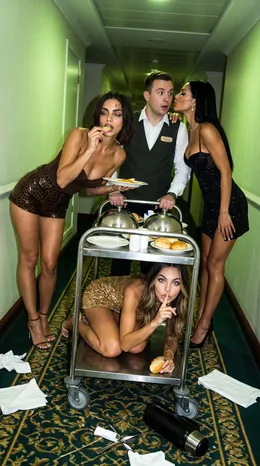
The Room Service Trolley
18

The Room Service Trolley

Green corridor · Numbered doors · Trolley

🍽 Stolen room service Emergency lighting Long hotel corridor
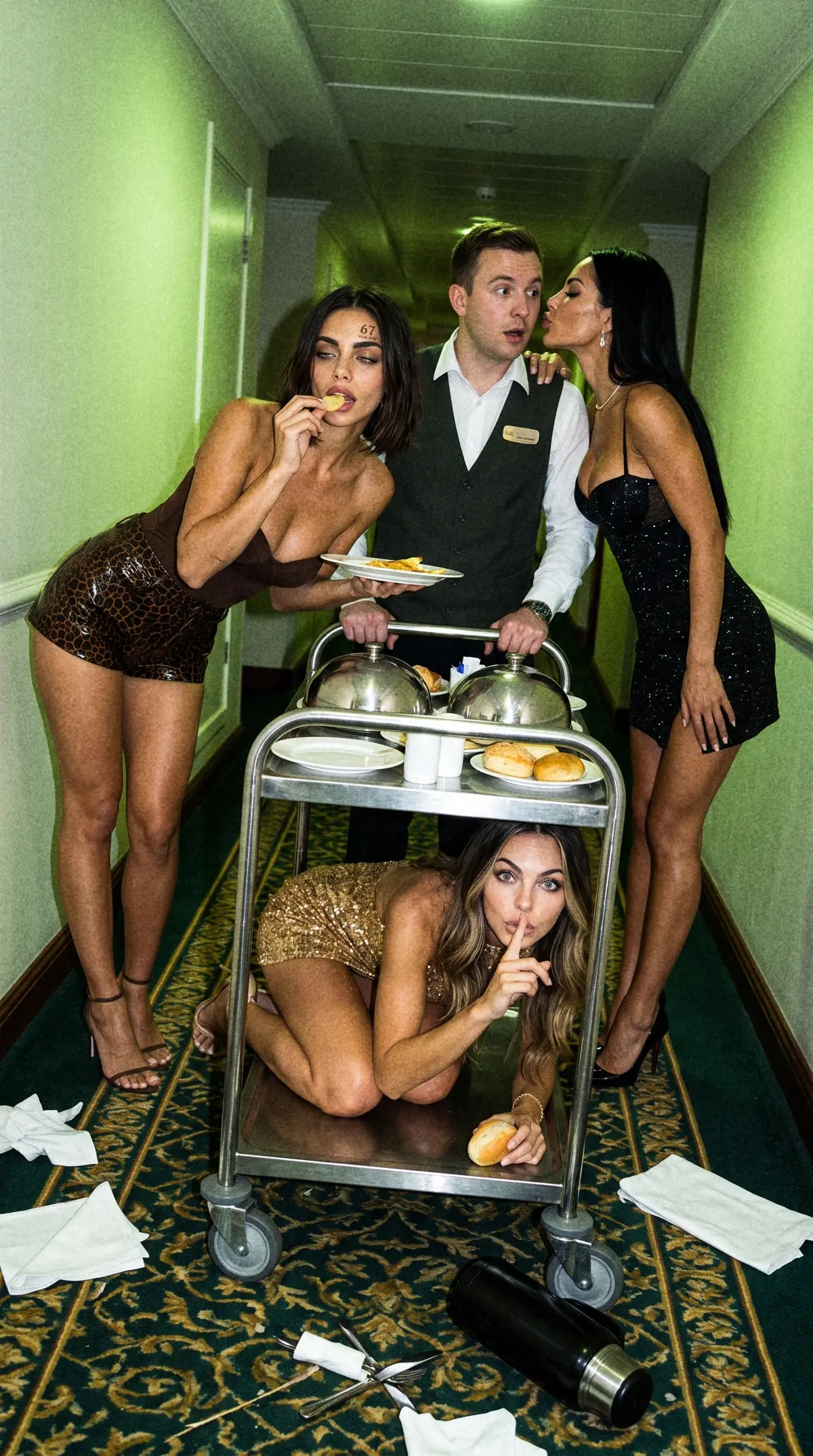
CAST — three specific people, locked to the reference images. image1 = Person 1 identity reference image2 = Person 1 outfit reference image3 = Person 2 identity reference image4 = Person 2 outfit reference image5 = Person 3 identity reference image6 = Person 3 outfit reference Person 1 = identity from image1 + outfit from image2 Person 2 = identity from image3 + outfit from image4 Person 3 = identity from image5 + outfit from image6 IDENTITY DISCIPLINE — THIS IS THE MOST COMMON FAILURE. AVOID IT. The three must read as three clearly different individuals. Copy each face from its own identity reference exactly: face shape, eyes, eyebrows, nose, mouth, skin tone, hair colour, hair length and hair style. Never blend two references into one face. Never give two people in this image the same face or the same hair — if two of them look alike, the image is wrong. Each outfit belongs to one person only: the clothing in image2 is worn ONLY by Person 1, the clothing in image4 ONLY by Person 2, the clothing in image6 ONLY by Person 3. Derive every garment only from that person's own outfit reference — exact pattern, exact texture, exact colour. Do not move a garment, a colour, a fabric or a print from one person to another, and do not invent a different outfit for anyone. Exactly three referenced people, each appearing exactly once. No fourth lookalike, no duplicate of anyone. THE TATTOO — SIDE IS CRITICAL. A small crooked hand-poked number 67 in black ink sits on Person 1's forehead above her LEFT eyebrow — her own left, the same side as her left eye and left hand — close to the hairline. Facing the camera this places it on the RIGHT half of the image, to the right of her nose from the viewer's point of view. If it ends up on the left half of the image, mirror it to the other eyebrow. It is a small clean black number and nothing else — no extra marks, no red patches, no scratches. Persons 2 and 3 have no facial tattoo. WHO IS WHERE — READ THIS TWICE BEFORE DRAWING. PERSON 3 (image5 + image6) is the one curled up inside the trolley. PERSON 1 (image1 + image2) is the one bent over the trolley eating. PERSON 2 (image3 + image4) is the one walking away down the corridor with a plate. THE MOMENT — a long hotel corridor late at night lit by sickly green emergency lighting, patterned carpet, numbered doors, an exit sign glowing at the far end. An abandoned room service trolley stands in the middle of the corridor, white cloth, silver domed cloches, a coffee pot, smeared plates. PERSON 1 is bent over the trolley from above, eating crisps off a plate with her fingers, eyes closed, plate held in her other hand. PERSON 3 has climbed onto the lower shelf of the trolley and is curled up inside it, knees pulled to her chest, hugging a bread roll, staring flatly out at the camera. PERSON 2 is much further down the corridor, walking away from the camera carrying a plate, glancing back over her shoulder. Napkins, a fallen thermos flask and scattered cutlery on the carpet. CAMERA A cheap 2009 pocket compact with direct on-camera flash. Harsh and unflattering: whatever is nearest the lens is slightly blown out and shiny, everything a few metres back drops away into dark, noisy murk. Ugly mixed white balance — sickly green corridor light fighting cold flash, magenta in the highlights. Visible sensor noise, JPEG mush in the dark areas, crunchy oversharpened edges. Skin keeps its texture and pores, but nobody has red blotches, rashes, broken veins, sunburn or red marks on the face — skin tone stays even and matches the identity reference. No smoothing, no gloss, no beauty retouch. Absolutely NO date stamp, NO timestamp, NO text, NO numbers and NO watermark anywhere in the frame. NOT A PHOTOSHOOT — nobody poses, the trolley is too close to the lens, the horizon is tilted, one person is far away and half turned. A bad photograph of a real moment, not a good photograph of a staged one. If the image would work as an advertisement, it is wrong.
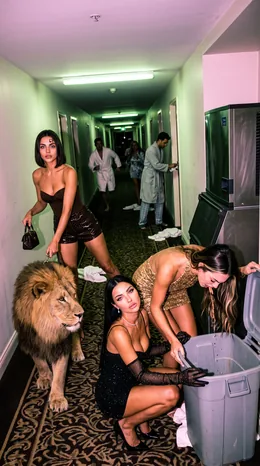
The Ice Machine
19

The Ice Machine

Dawn corridor · Green fluorescent · Rock bottom

🧊 Ice machine 🦁 Lion waiting The low point
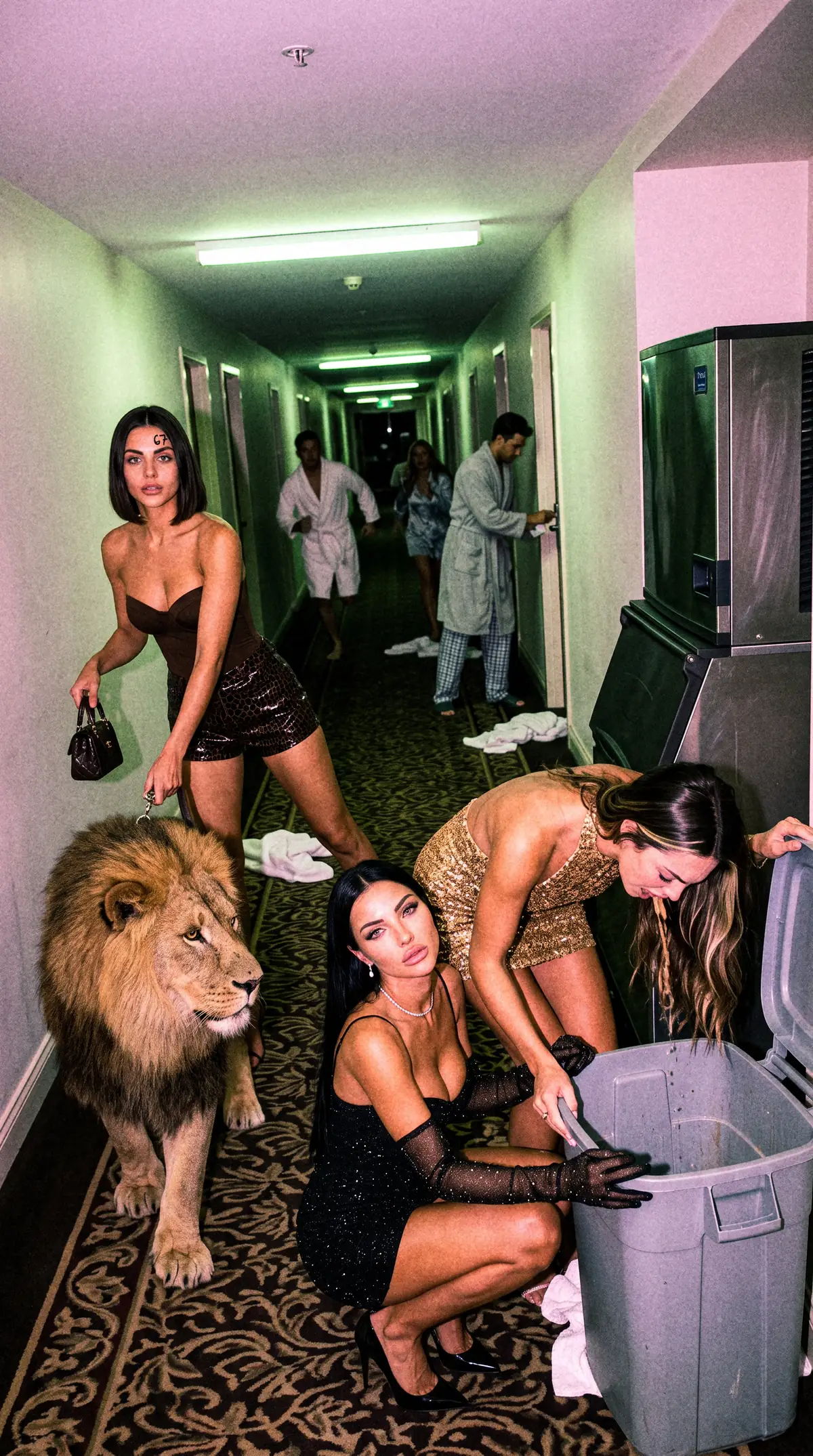
CAST — three specific people, locked to the reference images. image1 = Person 1 identity reference image2 = Person 1 outfit reference image3 = Person 2 identity reference image4 = Person 2 outfit reference image5 = Person 3 identity reference image6 = Person 3 outfit reference Person 1 = identity from image1 + outfit from image2 Person 2 = identity from image3 + outfit from image4 Person 3 = identity from image5 + outfit from image6 IDENTITY DISCIPLINE — THIS IS THE MOST COMMON FAILURE. AVOID IT. The three must read as three clearly different individuals. Copy each face from its own identity reference exactly: face shape, eyes, eyebrows, nose, mouth, skin tone, hair colour, hair length and hair style. Never blend two references into one face. Never give two people in this image the same face or the same hair — if two of them look alike, the image is wrong. Each outfit belongs to one person only: the clothing in image2 is worn ONLY by Person 1, the clothing in image4 ONLY by Person 2, the clothing in image6 ONLY by Person 3. Derive every garment only from that person's own outfit reference — exact pattern, exact texture, exact colour. Do not move a garment, a colour, a fabric or a print from one person to another, and do not invent a different outfit for anyone. Exactly three referenced people, each appearing exactly once. No fourth lookalike, no duplicate of anyone. THE TATTOO — SIDE IS CRITICAL. A small crooked hand-poked number 67 in black ink sits on Person 1's forehead above her LEFT eyebrow — her own left, the same side as her left eye and left hand — close to the hairline. Facing the camera this places it on the RIGHT half of the image, to the right of her nose from the viewer's point of view. If it ends up on the left half of the image, mirror it to the other eyebrow. It is a small clean black number and nothing else — no extra marks, no red patches, no scratches. Persons 2 and 3 have no facial tattoo. THE LION must be photographically real: correct anatomy and scale for a full-grown male lion, individual fur strands, real weight resting on the surface, lit by exactly the same flash and ambient light as the people, casting matching shadows, with matching grain and sharpness. Not a cut-out, not pasted in, not a plush toy, not a flat sticker. WHO IS WHERE — READ THIS TWICE BEFORE DRAWING. PERSON 3 (image5 + image6) is being sick into the bin. PERSON 2 (image3 + image4) is crouched beside her holding her hair. PERSON 1 (image1 + image2) is further down the corridor unclipping the lion's leash. THE MOMENT — a long hotel corridor at dawn beside a big steel ice machine and a grey plastic rubbish bin, sickly green fluorescent tubes, patterned carpet. PERSON 3 is bent double over the open bin being sick into it, hair hanging down, one hand gripping the rim. PERSON 2 is crouched beside her holding her hair back with one gloved hand and rubbing her shoulder with the other, looking up wearily at the camera. PERSON 1 is a few steps further down the corridor and has just unclipped the leash from the lion's collar — the leash dangling loose from her hand, the lion already stepping out into the corridor with its head up. Further down the hallway four or five hotel guests in dressing gowns and pyjamas are fleeing: one sprinting away from the camera, one flattened against a door fumbling with a keycard, one frozen mid-turn with her mouth open. Scattered towels on the carpet. CAMERA A cheap 2009 pocket compact with direct on-camera flash. Harsh and unflattering: whatever is nearest the lens is slightly blown out and shiny, everything a few metres back drops away into dark, noisy murk. Ugly mixed white balance — sickly green fluorescent light fighting cold flash, magenta in the highlights. Visible sensor noise, JPEG mush in the dark areas, crunchy oversharpened edges. Skin keeps its texture and pores, but nobody has red blotches, rashes, broken veins, sunburn or red marks on the face — skin tone stays even and matches the identity reference. No smoothing, no gloss, no beauty retouch. Absolutely NO date stamp, NO timestamp, NO text, NO numbers and NO watermark anywhere in the frame. NOT A PHOTOSHOOT — nobody poses, the horizon is tilted, someone is cut off by the frame edge, at least one face is softened by movement. A bad photograph of a real moment, not a good photograph of a staged one. If the image would work as an advertisement, it is wrong.
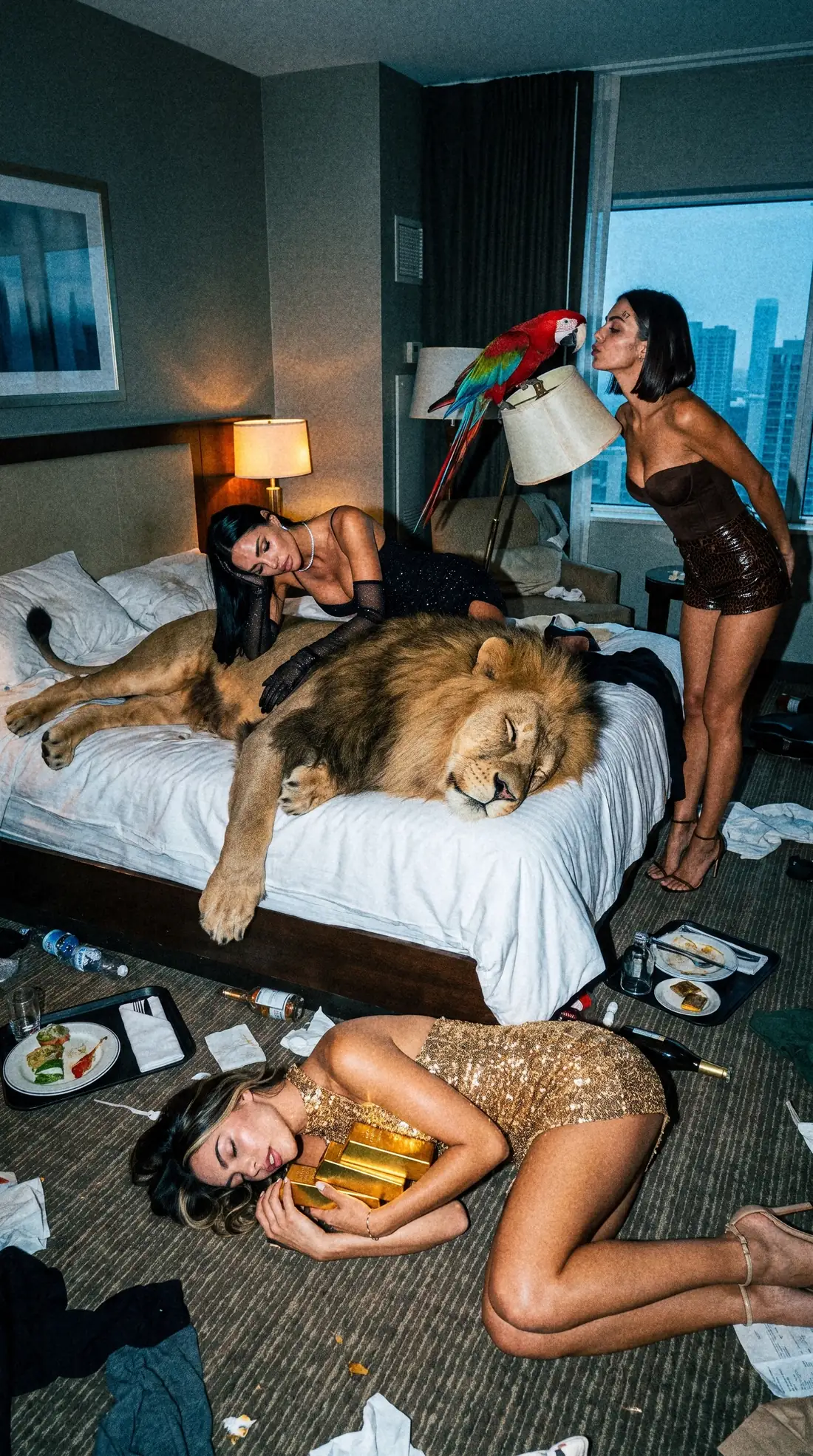
The Lion Has the Bed
20

The Lion Has the Bed

First light · Wrecked suite · Nobody wins

🦁 Lion asleep 😴 First light The end of it
CAST — three specific people, locked to the reference images. image1 = Person 1 identity reference image2 = Person 1 outfit reference image3 = Person 2 identity reference image4 = Person 2 outfit reference image5 = Person 3 identity reference image6 = Person 3 outfit reference Person 1 = identity from image1 + outfit from image2 Person 2 = identity from image3 + outfit from image4 Person 3 = identity from image5 + outfit from image6 IDENTITY DISCIPLINE — THIS IS THE MOST COMMON FAILURE. AVOID IT. The three must read as three clearly different individuals. Copy each face from its own identity reference exactly: face shape, eyes, eyebrows, nose, mouth, skin tone, hair colour, hair length and hair style. Never blend two references into one face. Never give two people in this image the same face or the same hair — if two of them look alike, the image is wrong. Each outfit belongs to one person only: the clothing in image2 is worn ONLY by Person 1, the clothing in image4 ONLY by Person 2, the clothing in image6 ONLY by Person 3. Derive every garment only from that person's own outfit reference — exact pattern, exact texture, exact colour. Do not move a garment, a colour, a fabric or a print from one person to another, and do not invent a different outfit for anyone. Exactly three referenced people, each appearing exactly once. No fourth lookalike, no duplicate of anyone. THE TATTOO — SIDE IS CRITICAL. A small crooked hand-poked number 67 in black ink sits on Person 1's forehead above her LEFT eyebrow — her own left, the same side as her left eye and left hand — close to the hairline. Facing the camera this places it on the RIGHT half of the image, to the right of her nose from the viewer's point of view. If it ends up on the left half of the image, mirror it to the other eyebrow. It is a small clean black number and nothing else — no extra marks, no red patches, no scratches. Persons 2 and 3 have no facial tattoo. THE LION must be photographically real: correct anatomy and scale for a full-grown male lion, individual fur strands, real weight resting on the surface, lit by exactly the same flash and ambient light as the people, casting matching shadows, with matching grain and sharpness. Not a cut-out, not pasted in, not a plush toy, not a flat sticker. WHO IS WHERE — PERSON 2 (image3 + image4) sits on the sleeping lion. PERSON 1 (image1 + image2) talks to the parrot. PERSON 3 (image5 + image6) is asleep on the carpet cuddling the gold bars. THE MOMENT — a wrecked hotel suite bedroom at FIRST LIGHT, not morning. It is the pale blue-grey half dark just before sunrise: the window shows a barely lit sky with the city still switched on, the room is still dim and shadowy, the bedside lamps are STILL SWITCHED ON and glowing warm, and the camera flash is by far the brightest thing in the picture. This is dawn twilight, NOT daylight, NOT a bright morning, NOT an evenly lit room. Room service trays, bottles and clothes everywhere. A full-grown male lion is stretched out fast asleep across the double bed, taking up the whole mattress. PERSON 2 sits astride the sleeping lion's back as if it were a sofa, slumped forward with her elbows on her knees, completely exhausted, hair flat on one side. PERSON 1 stands at the window a step away, leaning in close to a large scarlet macaw perched on a lampshade, her face right up to the bird, lips pursed, clearly talking to it and waiting for an answer. PERSON 3 has curled up on the carpet on her side with three heavy gold bullion bars hugged against her chest and chin, cuddling them like a soft toy, eyes shut, mouth open, fast asleep. CAMERA A cheap 2009 pocket compact with direct on-camera flash. Harsh and unflattering: whatever is nearest the lens is slightly blown out and shiny, everything a few metres back drops away into dark, noisy murk. Ugly mixed white balance — cold blue pre-dawn light through the window fighting the warm lamps and the cold flash, green in the shadows, magenta in the highlights. Visible sensor noise, JPEG mush in the dark areas, crunchy oversharpened edges. Skin keeps its texture and pores, but nobody has red blotches, rashes, broken veins, sunburn or red marks on the face — skin tone stays even and matches the identity reference. No smoothing, no gloss, no beauty retouch. Absolutely NO date stamp, NO timestamp, NO text, NO numbers and NO watermark anywhere in the frame. NOT A PHOTOSHOOT — nobody poses, the horizon is tilted, something is too close to the lens, at least one face is turned away. A bad photograph of a real moment, not a good photograph of a staged one. If the image would work as an advertisement, it is wrong.
Mia Maldini Las Vegas Hangover Edition
That’s it

Now steal the whole
night and see how
far yours goes.
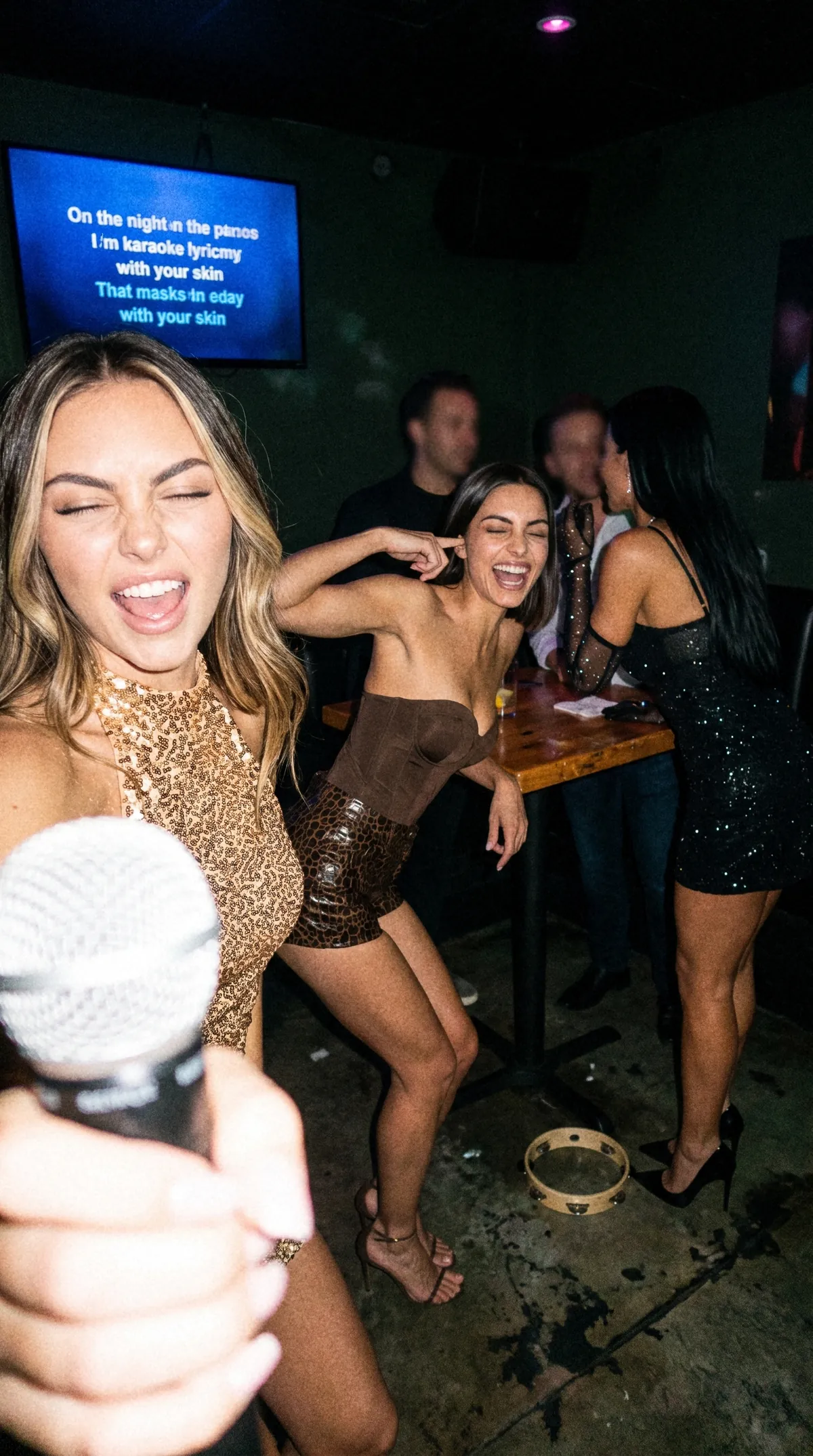

Twenty frames, from the lift doors to first light. Run them in order for the full story, or pick the ones you like. Tag me when you post — I want to see how your night ended.

Follow @miamaldini

“The future of content creation is not human or AI — it is the beautiful collaboration of both.”

Mia Maldini
miamaldini.com